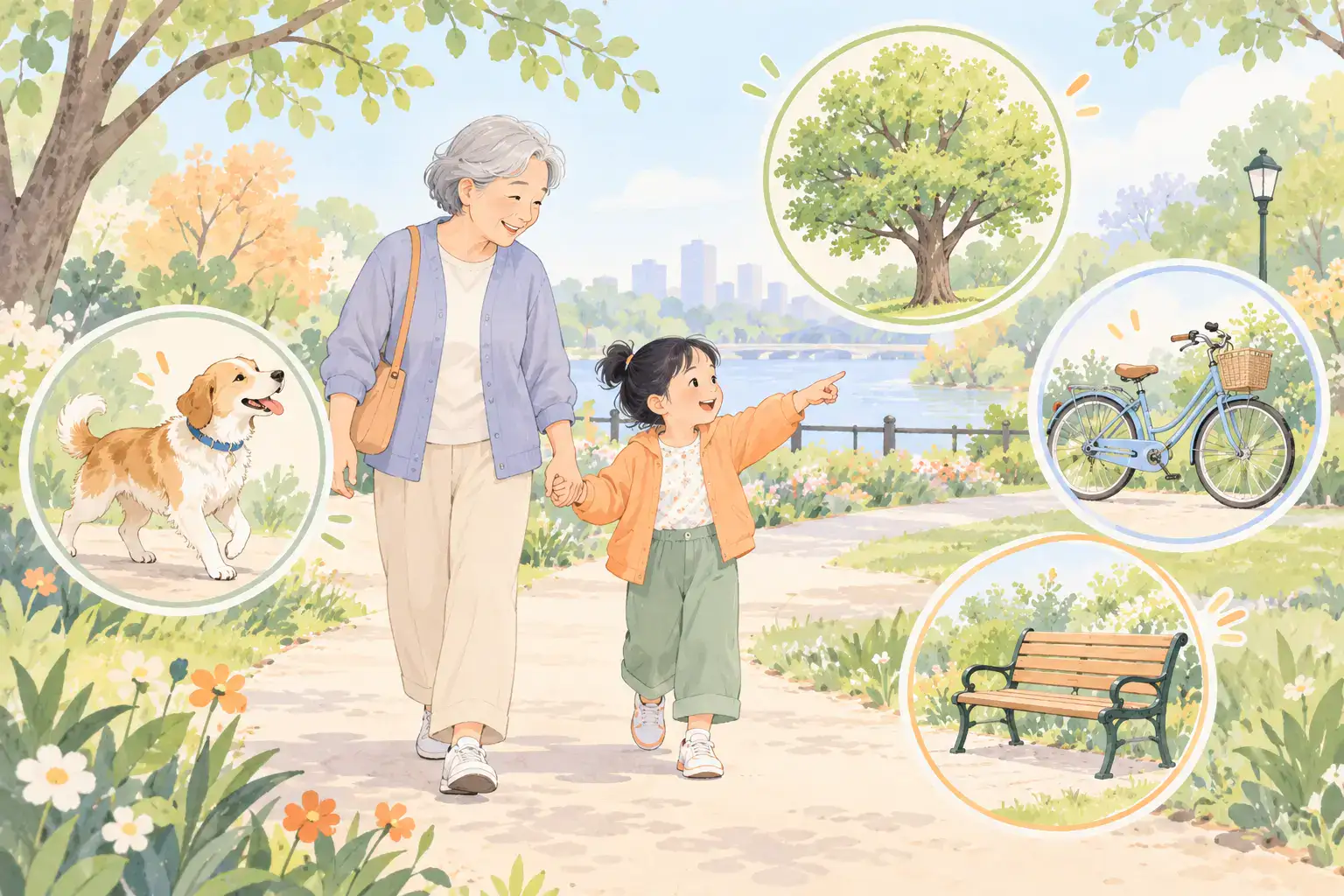
A dog, a bench, a bicycle: a short walk can produce a whole collection of nouns. You can play indoors too, looking around a room or exploring a picture together.
Start with things you can notice
Take paper and a pencil, or let your child point, sign, draw or dictate. Ten minutes and five interesting words are plenty. A noun can name a person, place, thing or idea. You do not need to introduce every noun category on the first outing.
Collect and sort
- Choose a few words from your surroundings, such as neighbour, park, dog, bench and happiness.
- Make a sentence with one: “The dog ran past the bench.” Find the nouns in it together.
- Compare a general name with a specific one. “City” is a common noun; “Nairobi” is a proper noun and begins with a capital letter.
- Add an idea or feeling, such as kindness or excitement. These are abstract nouns; you cannot point to them in quite the same way as a bench.
- Let your child choose another example and explain their thinking. Check an uncertain word together rather than turning uncertainty into a mistake to hide.
Words can belong to more than one group
“Dog” is both a common noun and a countable noun. “Kindness” is a common abstract noun. The labels describe different features; they are not always separate boxes.
Countable nouns can have singular and plural forms: one bicycle, two bicycles. In “some water”, water is uncountable. You can count containers or measures instead: two cups of water. Some nouns change their countable use with meaning, so a learner’s dictionary can be helpful.
Try one extra challenge
- Find a compound noun such as playground or bus stop. A compound can be written as one word or more than one.
- Notice a collective noun in a sentence: “A flock of birds flew overhead.” “Flock” names the group.
- Show possession: “Riya’s notebook is blue.” Here “Riya’s” is a possessive form.
Choose just one challenge, and use the terms your child’s school is teaching. Avoid collecting strangers’ names, taking photographs without permission or asking children to share private family information. Stay away from traffic and keep the walk accessible to everyone joining in.
End by making a funny sentence with three of your collected nouns. The point is noticing how words work in a sentence, not filling pages of identical lists.