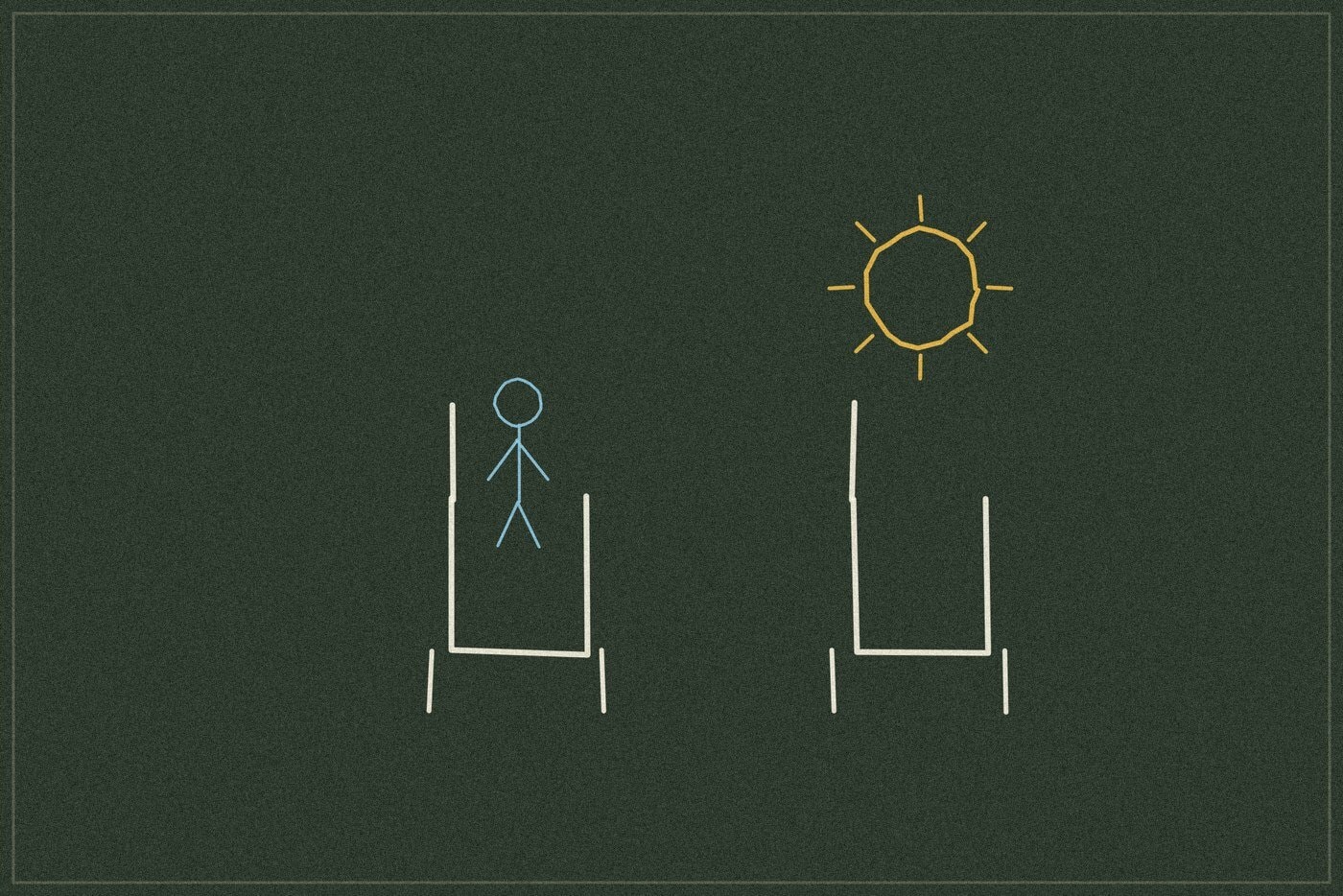
Two chairs, a handful of simple questions, and a child moving physically from one seat to the other to answer the same questions from a different vantage point in time. It is a small piece of theatre with a genuinely useful purpose: helping a child articulate hope and direction, in a format more engaging than simply being asked, “what do you want for your future?”
What you need
Two chairs or stools, set up facing each other or side by side, with enough space for several pairs to do this simultaneously around a room. A board or sheet of paper with the interview questions written where everyone can see them.
How to run it
Set up pairs or small clusters of two chairs around the room, enough for every pair in the group to have their own set. Label one chair “now” and the other “the future,” a year or two ahead, whatever feels right for the group’s age and context.
Write a short set of interview questions where everyone can see them. A good starting set:
- What is your name, and what do you enjoy doing?
- What is something you are looking forward to?
- What is your biggest hope or dream?
- What is one thing you want to get better at?
Pair children up, with one as interviewer and one as interviewee. The interviewee starts in the “now” chair and answers each question as themselves today. Then they move to the “future” chair and answer the same questions again, this time as themselves at the imagined future point. After going through the questions in both chairs, swap roles.
The conversation afterward
- Which chair was easier to answer from? Why do you think that was?
- Did your answers change much between the two chairs, or stay mostly the same?
- Which role did you enjoy more, asking the questions or answering them?
Why moving seats matters
The physical act of standing up and moving to a different chair does more work than it might seem. It gives a child permission to answer differently, as a slightly different, slightly older version of themselves, without it feeling like they are contradicting what they just said. Children who struggle to articulate hopes and plans in the abstract often find it considerably easier once there is a concrete prop, a specific chair representing a specific moment in time, to answer from.
What this is actually building
This activity gives children regular, low-pressure practice at a skill that genuinely matters and rarely gets deliberately practised: imagining a specific, positive future for themselves and putting it into words out loud, to another person who is listening closely. It also builds interview and active-listening skills in the partner’s role, since a good interviewer has to actually listen to the first answer before asking a thoughtful follow-up.
A note on keeping it forward-looking
Keep this activity firmly anchored in the present and the future, deliberately leaving out any “past” chair or questions about earlier times. This is a deliberate choice, not a missing feature: an activity designed to build hope and direction works better when it stays there, rather than risking an unplanned detour into memories a child may not be ready to revisit in a group setting, or that a parent or teacher is not equipped to properly hold if something difficult surfaces unexpectedly. If a child’s answers touch on something that clearly needs a more private, supported conversation, that is a cue to follow up with them individually afterward, not to pursue it in front of the group.
Adapting it
For younger children, simplify to two or three very concrete questions, such as “what’s your favourite thing to do” and “what’s something fun you want to do soon,” rather than more abstract hopes and dreams questions. For a one-on-one family version, a parent and child can simply take turns in the two chairs themselves, which often becomes a genuinely moving exercise for the adult as much as the child.