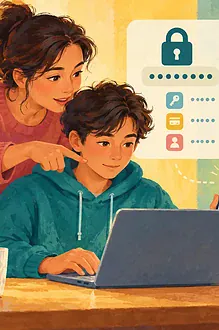
Multiplayer games can offer teamwork, creativity and a place to relax with friends. They can also bring children into contact with strangers, harsh language, pressure to spend and conversations that move quickly beyond the game. Safety does not require treating every player as dangerous—or giving a child unrestricted access.
Watch one session before making rules
Ask the child to show you the game lobby, team chat, direct messages, friend list, reporting menu and store. Find out whether chat is text, voice or video; whether strangers can contact them; and whether conversations can move to another app. Learn the game’s current age rating and platform settings.
For younger players, eSafety recommends limiting risky chat features and keeping play to known friends where possible. A family device setting can help, but controls are not a substitute for a child who expects a calm response when something goes wrong.
Agree on rules that fit real play
- Use a gaming name that does not reveal a full name, birth year, school or location.
- Keep real-world details private, including address, phone number, passwords, live location and travel plans.
- Ask before accepting requests. A friendly teammate is still someone the child may not know offline.
- Keep communication in approved spaces. Moving to encrypted or disappearing messages reduces adult visibility.
- No secret gifts or purchases. Treat offers of skins, currency and account upgrades as potential pressure.
- Know the exit. Practise mute, block, report and leaving a match.
Recognise a conversation that is changing
Concern should rise if a player asks for secrecy, personal photos, sexual talk, a private call, location details or a meeting; gives repeated gifts; becomes possessive; or threatens to expose messages. A person may pretend to be younger or use a compromised friend’s account.
Teach one simple response: stop replying, save the username and relevant messages, block or report, and tell a trusted adult. If the contact becomes personal, use the plan in when an online contact gets too personal.
Make reporting ordinary
Open the reporting menu together before it is needed. Show the difference between muting annoying behaviour and reporting threats, sexual requests, impersonation or targeted harassment. Save useful evidence before blocking when it is safe, but do not keep or forward illegal sexual images.
Promise that disclosure will not automatically mean losing all games. You may need to pause an account while addressing risk, but explain why and review the plan. Begin with, “Thank you for telling me. We will handle this together.”
Handle conflict and spending too
Not every gaming problem is stranger danger. Teammates may exclude, insult or pressure one another. Practise: “Stop. That is not okay,” “I’m muting this round,” and “I’m leaving the team chat.” The guide to first group-chat readiness has useful rules for consent and pile-ons.
Disable one-click purchases or require approval. Explain how countdowns, loot-style rewards and limited offers create urgency. Set a spending amount before play, not while the child is excited.
Adapt supervision by age and ability
- Ages 6–9: Prefer games with chat off or restricted to known people. Play nearby and use short sessions.
- Ages 10–12: Review contacts and privacy together. Rehearse what to do when a teammate asks to move platforms.
- Teens: Respect growing privacy while keeping firm boundaries around intimate images, money, threats and offline meetings.
Children who communicate differently may benefit from a visual exit card or a rehearsed message rather than having to explain danger in the moment. The parental-controls checklist can help with device setup. The aim is supported independence: enough protection to make play safer, and enough trust for children to tell the truth.