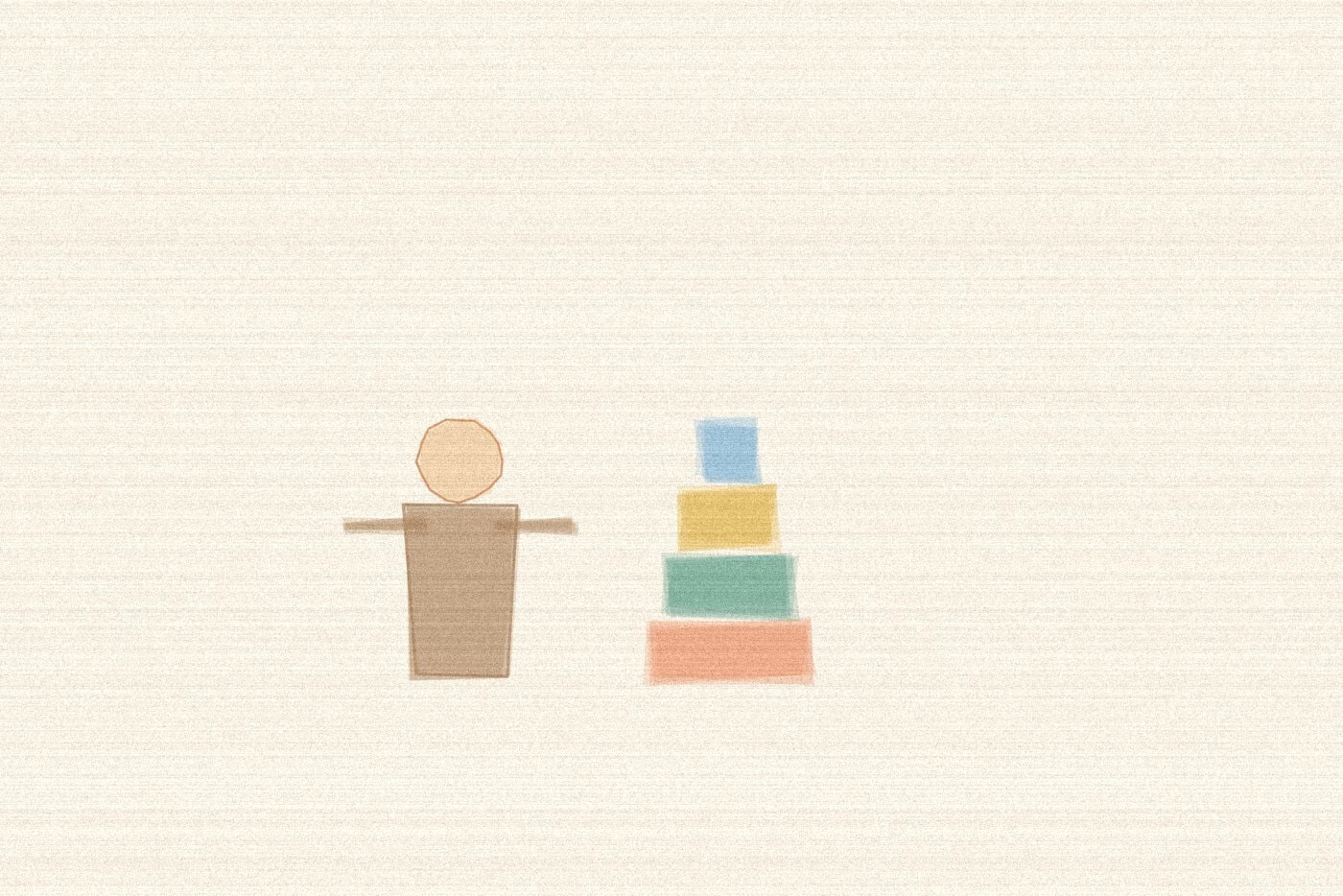
A handful of stacking rings or blocks, placed one on top of another, tower by wobbly tower. Stack It Up looks almost too simple to matter, and that is exactly what makes it such a reliable early activity: it genuinely meets a child wherever they are developmentally.
What you need
A set of stacking rings, blocks, or cups in graduated sizes, ideally in a range of colours.
How to play
For a baby or young toddler: place one object down in front of them and stack a second one on top while they watch, then hand them one to add themselves. Narrate what they’re doing, and let them explore freely, knocking the stack down is every bit as valuable a part of the activity as building it.
For an older toddler: put the whole set in the middle of a small group and let them explore and stack freely on their own first. Once they’re comfortable, talk through the sizes and colours together, and show them how to stack from biggest to smallest if they haven’t discovered it themselves, then watch whether they imitate you.
For a pre-schooler: turn it into a sorting and comparing task. Ask them to find every item of the same size, then the same colour, then line everything up from smallest to biggest, then count how many items are in each group. For a bit more challenge, ask simple addition and subtraction questions using the physical objects: “if we had three, and I took one away, how many are left?”
Why it works
What makes stacking genuinely useful across such a wide age range is that the same simple materials ask something slightly different of a child at each stage, from pure cause-and-effect at the youngest ages, to real early maths once a child is ready for it. Nothing about the toy changes. What a child does with it, and what they’re learning from it, changes considerably.
A stack of rings that topples over is not a failed activity. For a baby, the crash is often the best part. For a pre-schooler, rebuilding it correctly after a sibling knocks it down is its own small lesson in patience. Either way, the same simple set of objects keeps teaching something new for years, long after a parent might have assumed a child had outgrown it.