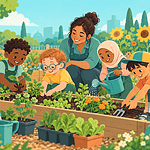
Climate worry can begin with a lesson, a disaster, a social-media post or a child’s own experience of heat, smoke or flooding. Dismissing it as overreaction leaves the child alone with the fear. Catastrophic language is not helpful either. The useful middle is honest listening, manageable science and action that restores some agency.
First, understand what the conversation needs to do
Ask what the child has heard and what they think will happen. Correct one misconception at a time and distinguish a serious long-term problem from an immediate personal emergency. Validate the feeling without confirming the worst prediction.
A practical way forward
- Limit repeated exposure to alarming clips, especially near bedtime, while not pretending the issue is unreal.
- Use simple reliable science and look up uncertain facts together rather than offering false certainty.
- Choose one proportionate family or community action linked to the child’s interests, such as a school garden or clean-up.
- Protect rest, play, friendships and time outdoors; a child is not responsible for solving a global crisis.
Words you can use
Try: “I can hear that this feels frightening. Let us separate what is happening now from what might happen later, then choose one useful thing we can do together.” A short opening is enough. Pause, listen, and let the child’s next question guide the depth of the answer. If they do not want to talk, say you will check back without making them responsible for restarting the conversation.
Adapt the message to age and ability
Primary-age children benefit from concrete local examples and visible solutions. Older children can discuss policy, fairness and collective action, but still need adults to carry adult responsibility. Avoid placing a family’s carbon decisions on a child’s conscience. Children who communicate differently may benefit from visual schedules, pictures, written choices or extra processing time. Keep the core message consistent even when you simplify the words.
What to avoid
- Do not promise that nothing bad will happen.
- Do not flood the child with statistics.
- Do not make individual purity the measure of being a good person.
When to bring in more help
Seek help if worry persistently disrupts sleep, eating, school, relationships or enjoyment, or if the child expresses hopelessness or self-harm. A pediatrician or mental-health professional can assess the whole picture, including other sources of anxiety.
One conversation rarely finishes a difficult subject. Return in ordinary moments, notice behaviour as well as words, and keep warmth and boundaries together. Useful related reading includes bridging communication gaps, building a trusted-adult network, and supporting worries and knowing when to seek help.
Make the plan workable in real life
Action helps when it is chosen, shared and proportionate. A child might help reduce household waste, protect a local green space, join a school project or write to a decision-maker. Frame this as participation with others, not a test of whether one family can prevent climate change alone.
Balance difficult information with evidence that people are working on solutions. News breaks, sleep routines and time outdoors can help regulate the body. If your own fear is high, process it with adults so the child does not have to reassure you. Hope is not denial; it is the belief that action and care still matter.
- Choose a calm time rather than starting in the heat of conflict.
- Ask the child to repeat the plan in their own words.
- Write down the next small step and who will help.
- Return to the subject after the child has had time to process it.
Some climate effects are already part of children’s lives. Practical preparation for heat, smoke, storms or flooding can reduce uncertainty when it matches local risks. Present preparation as ordinary family care, not evidence that disaster is inevitable.