Young people with intellectual disability experience puberty, curiosity, attraction and relationships. They need accurate teaching, not silence or a one-off warning. Start before changes feel urgent, use clear language, and revisit the same ideas in different situations. The goal is not to frighten a child away from relationships. It is to build body knowledge, autonomy, boundaries and reliable ways to get help.
Name bodies and changes plainly
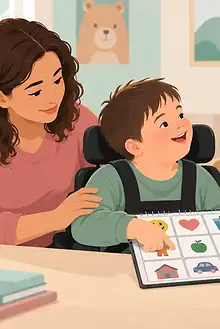
Teach accurate names for body parts alongside the words your family commonly uses. Explain menstruation, erections, body hair, sweat, voice changes and emotional shifts in short, concrete lessons. Use the child’s preferred communication—speech, sign, pictures, AAC, models or a simple booklet. Avoid euphemisms that make it harder to report pain or unsafe touch.
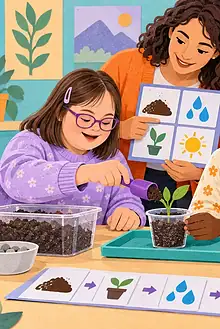
Break self-care into steps and practise before it is needed. A menstrual-care routine might include noticing a body signal, finding supplies, changing in a private place, wrapping used products and asking for help. A shaving or deodorant routine can use the same visual sequence approach as other daily-living skills.
Teach privacy as a rule with reasons
“Private” should not mean shameful or secret. Explain that private body parts and activities need privacy because everyone deserves control over their body. Be specific about places: a bedroom with the door closed or a bathroom may be private; a classroom or bus is public. Context matters, so teach exceptions too—for example, a clinician may examine a body part for health reasons after explaining, seeking consent or assent, and using appropriate support.
Pictures of familiar places can help a young person sort public and private activities. Review the rule when settings change. A shared bedroom, residential trip or public changing room may need a more detailed plan than the rule used at home.
Practise consent in everyday life
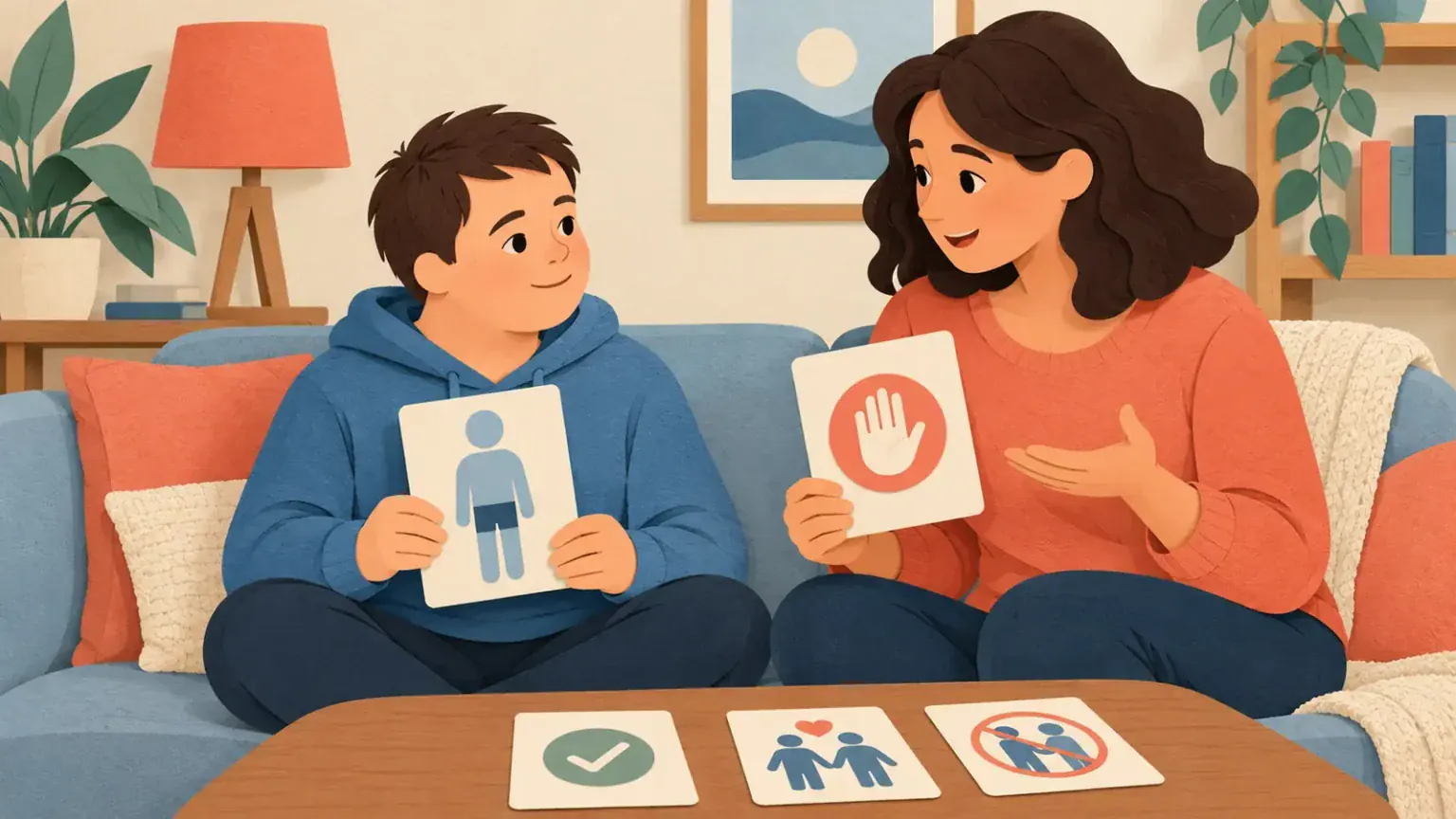
Consent is a freely given, informed and changeable yes. Teach it through ordinary interactions, not only sexual safety. Ask before hugs, tickling, hair care or borrowing belongings. Respect “no” when the activity is optional. Model stopping immediately: “You said stop, so I stopped.” Let the child see adults accept one another’s boundaries without sulking or pressure.
Teach both sides: they may say no, and they must notice another person’s no, stop, body movement or communication. “No answer” is not a yes. Someone can change their mind. A person who is asleep, intoxicated, frightened, confused or unable to understand cannot give meaningful consent. Use short scenarios and ask, “What could each person do next?” rather than demanding memorized slogans.
Separate surprises from unsafe secrets
A surprise has an ending and usually makes someone happy. An unsafe secret is one a person is told never to share, especially about bodies, touching, threats, gifts or online contact. Help the young person identify several trusted people, including someone outside the immediate household. Give them words or symbols for “I need to tell you something,” “I felt unsafe” and “Please believe me.”
Make clear that abuse is never the child’s fault, even if they froze, complied, accepted a gift, broke a rule or did not tell immediately. If a child discloses harm, stay calm, listen, do not interrogate, protect them from further contact and follow local safeguarding and emergency procedures.
Include relationships and online life
Teach the difference between acquaintance, friend, family member, professional helper and romantic partner. Discuss what respectful relationships look like: mutual interest, space for disagreement, no threats, and no demand for money, passwords or private images. Use actual examples from messaging, games and social media. Explain that images can be copied and that adults should help with privacy settings without reading every conversation by default.
Do not assume a young person is uninterested in romance because they communicate differently. Ask without pressure. Include diverse orientations and identities in a neutral way. A pediatrician or qualified sexuality educator familiar with disability can help tailor information to health, culture and comprehension.
Keep the teaching accessible
- Teach one idea at a time and repeat without making the learner feel tested.
- Use the same key words across home, school and care settings.
- Practise with role-play, pictures and real routines—not only abstract conversation.
- Check understanding by asking the young person to show what they would do.
- Update the plan as independence, technology and relationships change.
Our guide on respecting touch sensitivity during necessary care offers more examples of assent and preparation. Accessible sexuality education is not an optional extra. It is part of health, safety, belonging and the right to direct one’s own life.