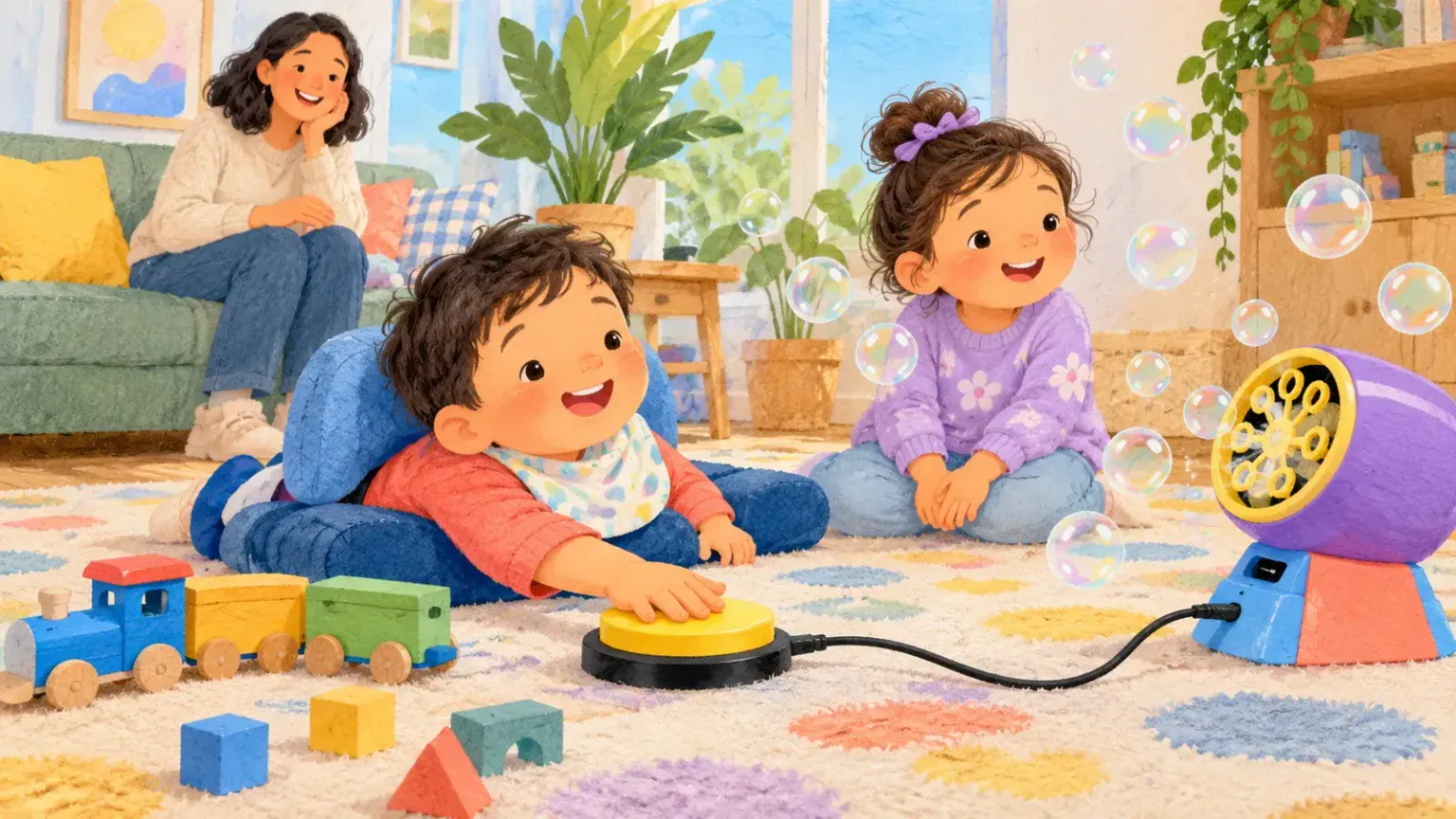
Switch access can give a child control over a toy, sound, light or digital activity through one reliable movement. The first goal is not rapid scanning or complicated computer use. It is the powerful connection between “I act” and “something I chose happens.”
Choose a meaningful effect
Start with something the child already enjoys: bubbles, music, a fan, vibration, a toy train or a simple animation. The effect should be immediate and easy to notice. Avoid overwhelming lights, sound or movement, and supervise any toy with small parts, cords, batteries or moving mechanisms.
A large switch is not automatically the right switch. A specialist may help identify a movement the child can repeat comfortably—hand, head, foot, elbow or another controlled action—and the size, sensitivity and position that reduce strain. Stable seating and a securely mounted switch are essential.
Set up one clear action
- Place the child comfortably with the switch within an easy, repeatable movement.
- Show the effect once without repeatedly moving the child’s body for them.
- Reset, pause and wait. Some children need much longer processing time than adults expect.
- Respond to the child’s action with ordinary delight: “You turned it on.”
- Stop after a few successful turns while the activity is still enjoyable.
If holding a switch down is difficult, an assessed timer or latch function may let one press run the toy for a short period or toggle it on and off. Do not wire mains-powered appliances through improvised adapters; use approved equipment and qualified guidance.
Move from cause-and-effect to choice
Once the action is reliable, introduce a predictable pause so the child can restart. Then practise turn-taking: the child activates bubbles, a sibling pops them, and they swap roles. Later, offer two effects and let the child indicate which to connect. Keep language simple and give access to “more,” “stop,” “different” and “my turn” through speech, gesture, pictures or AAC.
The activity should remain real inclusive play, not endless therapy disguised as a game. Siblings and peers can wait, copy, laugh and contribute rather than becoming assistant trainers.
Watch for signs the setup needs changing
Repeated misses may mean the switch moves, the target is too small, the child is poorly positioned or the required movement is tiring. Random hitting may mean the effect is unclear or the pace too fast. A child who looks away, stiffens, becomes upset or stops trying may need a different reward, quieter setting or break.
Record which position, switch and effect worked, so school and home do not make the child relearn a different setup every day. The article on teaching digital access tools one task at a time offers a next step when play begins to extend to tablets or computers.
Keep the child in charge
Do not press the switch for the child after every pause or physically force a movement. Model, wait and adjust access. End when the child communicates “finished,” even if the adult planned ten turns. The measure of success is not the number of presses. It is whether the child experiences reliable, enjoyable control and can use that control with other people.
Build variety without losing predictability
When the child understands the basic action, keep the access movement stable while changing the game. One day the switch starts music for a dance; another day it releases bubbles for a sibling; later it advances a simple story. This helps the child learn that the switch is a flexible way to act, not part of one toy. Still, present only one new demand at a time. If you introduce a new switch position, new toy and turn-taking rule together, it becomes difficult to see what caused confusion. Celebrate clear communication, including refusal. A child who presses “stop” or looks away is exercising control. That is as important as starting the effect.
Coordinate home, school and therapy without turning play into homework
Adults can share the switch position, access movement, wait time and signs of fatigue so the child meets a consistent setup. They do not need to repeat the same drill everywhere. Home can use music and family games; school can use stories, art or group choices. Send short observations—“reached accurately from the left side for five minutes”—rather than judging motivation. If the child cannot activate the switch reliably, return to positioning and assessment instead of increasing prompts. As control develops, make sure the child also has access to communication and ordinary toys that do not depend on adult praise. Choice and fun remain the purpose of play.