Yesterday already contains plenty of material for a grammar game: a bus journey, a drawing, a conversation over lunch. This activity turns a few ordinary memories into sentences about the past.
What you need
Use paper and a pencil, picture cards or a voice recorder. Allow about 15 minutes. Choose the level that fits what your child is learning at school. Start with two or three sentences; you do not need a diary of the whole day.
Make a tiny timeline
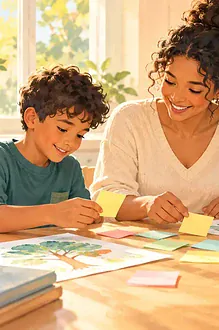
- Ask your child to choose three things they remember from yesterday. They can draw or dictate them.
- Put the moments in order. “I ate lunch. I played outside. I read a story.”
- Choose one moment and describe what was happening then: “At four o’clock, I was building a tower.”
- For a more advanced round, connect two past moments: “I had packed my bag before we left.”
- Read the sentences together. Ask what the reader learns about the order or duration of events.
Four forms, with a reason to use each
- Past simple: “I painted a leaf yesterday.” It presents a past event as a whole.
- Past continuous: “I was painting when the doorbell rang.” It shows an activity in progress at a past moment.
- Past perfect: “I had finished the picture before we went out.” It looks back from one past point to something earlier.
- Past perfect continuous: “I had been painting for twenty minutes when we stopped.” It draws attention to the activity and its duration before a past point.
These forms are choices about meaning, not four boxes that every memory must fill. Past perfect continuous does not, by itself, tell us that an activity finished forever. Keep the surrounding sentence in view.
Keep the remembering comfortable
Use daylight moments your child chooses. There is no need to set alarms late at night, interrupt sleep or record what other people are doing without their permission. A made-up character’s day works if your child would rather keep their own day private.
For a simpler version, stay with past simple and model irregular forms gently: “You went to the park. What did you see?” For an older learner, compare two sentences and ask how the meaning changes. Stop while it still feels like a short story rather than an interrogation.