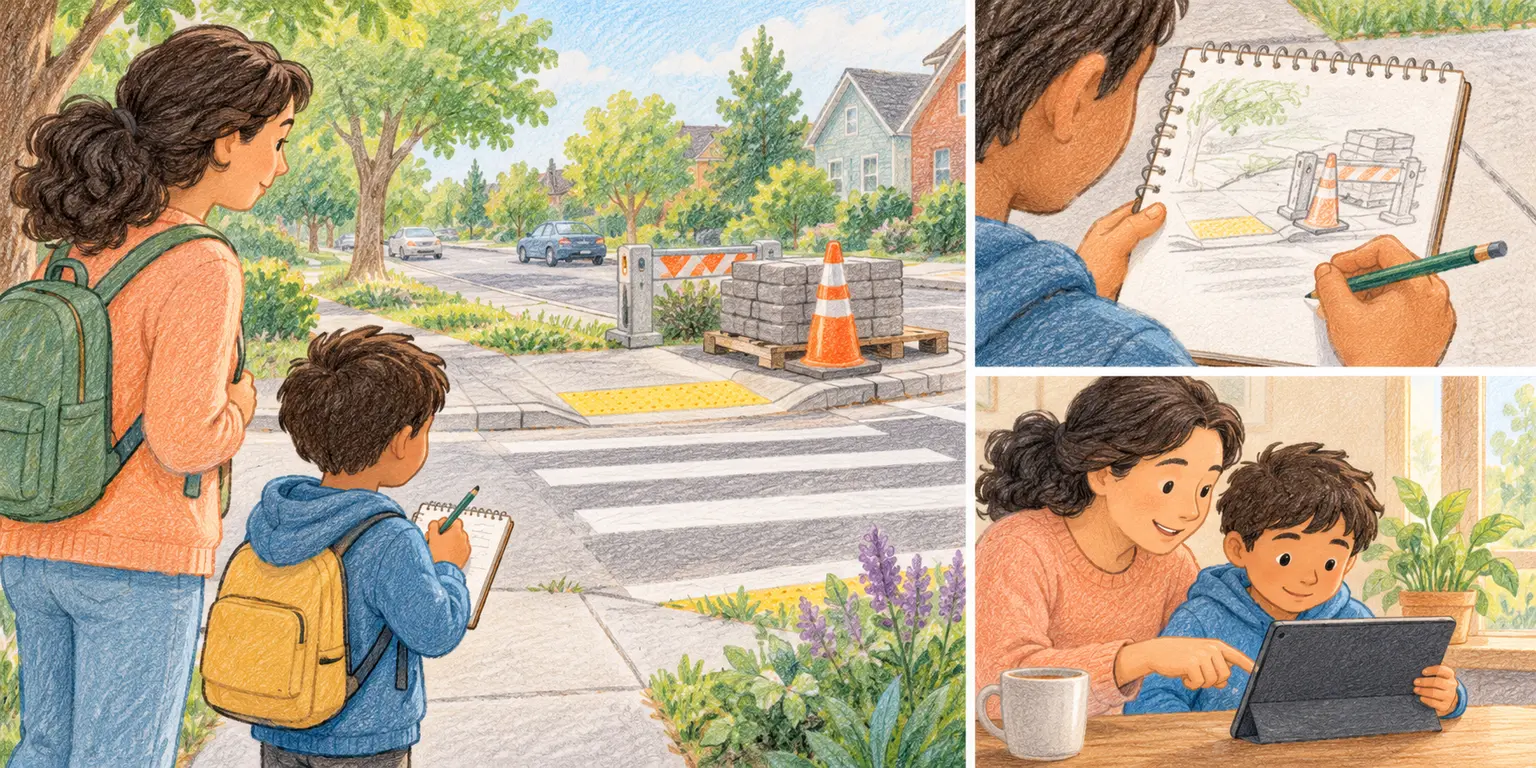
Children notice details adults miss: a path that a wheelchair cannot use, a crossing where drivers cannot see, or a park tap that never works. A civic request turns one observation into accurate information and a realistic proposal. It is not a demand that a child fix the system.
- Choose one safe observation
- Use the FACT note
- Check the request before sending
- Offer evidence, not a campaign
- Plan respectful follow-up
- Reflect on outcomes
- Write the request in four sentences
- Test observation against interpretation
- Choose privacy before publicity
- Make follow-up proportionate
- Celebrate civic patience without accepting danger
- Sources and further reading
Choose one safe observation
Use something visible from an ordinary route with an adult. Do not inspect traffic, construction, exposed wires, drains, aggressive animals or isolated places. If there is immediate danger, move away and use the appropriate emergency or adult reporting route.
Use the FACT note
- F: Fact observed: what could be seen or heard without guessing motives.
- A: Area: a public location described without revealing a home address.
- C: Consequence: who may find access, safety or use more difficult.
- T: Thoughtful request: one action the responsible service could consider.
For example: “The kerb ramp beside the public library is blocked by a fixed bin, which makes access difficult for wheelchair and pushchair users. Could the relevant service review the placement?”
Check the request before sending
- Confirm the correct public service or property manager.
- Remove accusations and claims the family cannot verify.
- Keep identifiable people out of photographs.
- Ask an adult to review privacy and safety.
- Use an official website, number or service desk.
UNICEF and UN-Habitat guidance connects children’s participation with inclusive urban decisions, planning and services. The family activity is a small practice, not a substitute for formal safeguarding or legal channels.
Offer evidence, not a campaign
One date, time and clear location may be enough. Children should not gather signatures from strangers, publish an official’s personal details or organise confrontation. If a pattern needs evidence, an adult can decide how to document it safely.
Plan respectful follow-up
Record the reference number and a reasonable review date. If there is no response, check the published escalation route or contact an elected representative with the same factual note. Avoid repeated messages that overwhelm the service.
Reflect on outcomes
The request may be accepted, redirected, delayed or declined. Ask what was learned about responsibility, evidence and competing needs. Praise the quality of participation, not only whether the preferred change happened.
Build the same habits through giving children a real voice in family decisions, guiding a group decision without taking over, and making a fair choice when needs compete.
Write the request in four sentences
Try this structure: “On two mornings this week, we observed… This affects… We are asking the responsible service to consider… Please let us know the correct reference or next step.” Keep it short enough that the main issue cannot be lost in background details.
Test observation against interpretation
- Observation: “The crossing signal did not light during two complete cycles.”
- Interpretation: “The council does not care about children.”
- Observation: “Three steps lead to the only public entrance.”
- Interpretation: “Nobody planned for disability.”
The interpretation may express a real concern, but a first service request is stronger when it begins with verifiable facts and access impact.
Choose privacy before publicity
A public social-media post can reveal a child’s route, school or home area and may not reach the responsible team. Start with an official channel. If wider advocacy later becomes appropriate, adults should assess consent, safeguarding and local rules.
Make follow-up proportionate
One clear follow-up after the published response period is usually more useful than daily messages. If responsibility is disputed, ask each office to identify the correct route. Keep correspondence factual and save reference numbers.
Celebrate civic patience without accepting danger
Routine improvements can take time, but immediate hazards need the appropriate urgent route. Teach both ideas together. Children can learn persistence without being told to tolerate unsafe conditions or personally solve them.
Finish by asking: Was our request accurate, respectful, safe and directed to someone able to act? Those qualities remain valuable even when the answer is delayed.