By EdCaptain editorial desk · Published
Your child likes the idea of a science or story podcast in English, but a minute into it they ask, “What are they saying?” You explain one sentence and miss the next. Soon the programme is mostly pauses, translations and frustration.
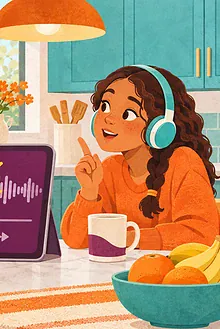
You do not have to choose between leaving a child lost and translating the whole episode. For children aged 6–12 who are learning English as an additional language, try a small piece of audio with a clear purpose and enough support to follow its meaning. This is an optional family listening routine, not a fluency test or a timetable for progress.
First check what makes this recording difficult
Listen to a short section yourself. Is there one clear speaker, or several people interrupting each other? Does understanding depend on unfamiliar jokes, scientific terms or events from earlier episodes? Is background music covering the words?
A child might know a topic well in another language and still find this particular recording difficult. Changing the recording is often more useful than repeating “listen carefully”. Choose an age-respectful subject the child already enjoys, with a clear setting or question. An older beginner does not have to accept babyish stories simply because the vocabulary is simpler.
If the child is not interested today, leave it. The British Council’s family listening tips suggest letting children choose a favourite story or song to hear together. Choice can begin with whether they want audio at all.
Prepare a short listening invitation
You need a caregiver-controlled device, a previewed extract, and optionally paper with a pencil. A shared speaker at a comfortable level lets you both hear and pause. Sit somewhere you can talk without competing with television or other audio. No account, worksheet or new purchase is needed for the routine itself.
Choose a complete little moment rather than an arbitrary stop halfway through a sentence. For example, use a short weather story in which a character decides what to wear. Agree that the first attempt will end after that scene, even if the episode continues. Preview the whole chosen extract for advertising, frightening material and suitability.
Before playing, give just enough context: “Someone is getting ready to go outside. Let’s find out what the weather is like.” Explain that in your shared home language if it helps. Introduce one or two essential words, such as windy or raincoat, with a gesture or sketch. You do not need to teach every unfamiliar word.
Try one small question, then decide together
- Agree what to listen for. Draw a sun, rain cloud and windswept tree, or simply offer those choices aloud. Say, “Which weather do you think is in this scene?” The pictures are optional supports, not answers the child has to memorise.
- Play the short scene once. Let the child take in the overall situation. Avoid interrupting to ask for translations. They can listen while holding a cushion or looking away; sitting perfectly still is not part of the task.
- Invite a response in any useful form. They might point, draw, gesture, speak English or explain in another language. “I heard something about rain, but I’m not sure” is a useful response too. Share what you understood without awarding marks.
- Offer a choice about replaying. Ask, “Again, a quick explanation, or finished?” If they choose another listen, return to the same scene with one clue. If they prefer an explanation, give the meaning briefly rather than turning it into a vocabulary drill.
- Close with a real decision. Ask whether this is something they would like to hear again another day. Keep the option to choose an easier recording, a familiar story or no podcast.
This home example draws on a general listening sequence described in British Council TeachingEnglish guidance: prepare the topic, listen for the main idea, and return for detail when useful. It is a suggested adaptation, not evidence that a particular number of replays produces a learning gain.
Use translation as help, not an endless commentary
If your child asks what something means, answer. There is no prize for struggling without support. A brief home-language explanation can make the situation clear enough to enjoy the next listen. You can also admit, “I didn’t catch that phrase either.”
What tends to become impractical is trying to talk over every sentence while the audio keeps moving. Pause first, explain the important point, and choose together whether to continue. Keep ordinary family conversation in the languages that let you connect comfortably; our guide to supporting the home language alongside English explores that wider question.
Adjust the support without making it harder to belong
For ages 6–9, offer two or three pictures or simple spoken choices. An adult can draw while the child directs. Keep the focus on one scene; reading and writing are not entry requirements.
For ages 10–12, let the child choose an age-respectful topic and identify what they want to understand: a character’s decision, the answer to a science question, or one explanation. They can jot a word, sketch an idea or tell you privately that the recording is too difficult. Avoid asking them to perform their English for relatives.
If written words help, offer the publisher’s transcript. If text makes listening more tiring, put it away. See our guide to using podcast transcripts accessibly for format choices. A child who uses AAC can select “again”, “explain”, “different” or “stop”; allow the time they need to respond.
Do not raise the volume to solve a language-comprehension problem. Remove competing sound, change the recording or use another format. If audio is inaccessible, a supported written or visual version is a valid choice, not a lesser attempt.
Know when to change the plan
If the child keeps guessing without understanding, looks uncomfortable or spends the whole session waiting for explanations, stop. Next time, choose a more familiar subject or a shorter, clearer scene. Do not add extra listens as a penalty.
One enjoyable moment of understanding is enough to end on. The question afterward is “Did this way of listening work for you?” rather than “How many new words did you learn?” Keep the answer available as a choice, including “not today”.
Sources and further reading
- British Council TeachingEnglish: Kids and listening — teaching guidance on preparing and supporting listening.
- British Council LearnEnglish Kids: Listen to stories and songs — choosing audio to enjoy together.
- EdCaptain editorial policy.