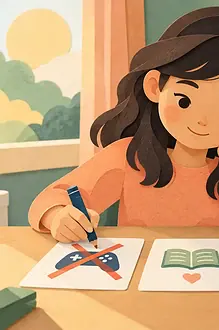
Peer pressure often arrives disguised as urgency: “Come on, decide now,” “Everyone is doing it,” or “Don’t be boring.” A young person who has to invent a perfect refusal while also managing fear of exclusion is doing two hard jobs at once. A pause plan gives them a rehearsed third option: delay, leave and contact support before the situation gathers momentum.
Build the plan before it is needed
Choose a calm moment, not the car ride after an incident. Ask, “What kinds of situations make it hardest to think?” Your child may name dares, unsafe transport, substances, sharing an image, trespassing, cheating or a friend demanding secrecy. Listen without turning every example into a lecture. You are gathering information for a usable plan.
Agree on three actions: a line to create time, a way to exit and a person to contact. Keep them short enough to remember under stress.
Rehearse ordinary exit lines
- “I’m not deciding that right now.”
- “I need to check something first.”
- “No, I’m heading out.”
- “That is not worth the risk for me.”
- “My family expects me. I have to go.”
Your child does not owe a courtroom argument. Repeating one sentence and moving toward a safer place can be more effective than debating. If direct refusal feels unsafe, a face-saving excuse is acceptable. Safety matters more than delivering an ideal speech.
Create a no-questions-first rescue code
Pick a neutral word, emoji or phrase that means, “Call me and give me a reason to leave,” or “Please collect me.” Decide who else can respond if you are unavailable. Tell your child exactly what will happen: “I will first help you get somewhere safe. We will talk about the details when everyone is calm.”
This is not a promise that choices have no consequences. It separates immediate safety from later accountability. A teen is more likely to ask for help if the first response is not humiliation, shouting or a public interrogation. The guide to asking for help confidently can help practise the contact step.
Use a risk check that fits in one breath
Teach three questions: “Could someone get hurt? Could this be hard to undo? Would I hide it from a trusted adult?” One “yes” is enough to pause and seek help. Adults should be explicit that certain situations are not youth-owned decisions: getting into a car with an unsafe driver, weapons, threats, sexual pressure, dangerous substances, sharing intimate images or immediate risk of harm.
If anyone is in immediate danger, your child should contact local emergency services or a nearby trusted adult. If sexual coercion, exploitation, violence or threats are involved, prioritize safety and professional support rather than trying to manage the situation as ordinary friendship conflict.
Practise without making the child perform
Offer a scenario and let your child choose a response. You can act as the persistent peer while they practise repeating the line, moving away and sending the code. Some children will prefer writing possible messages or rehearsing privately. Do not require eye contact, a loud voice or a clever comeback.
For ages 10–12, keep scenarios concrete and make the trusted-adult list visible. Teens can map transport alternatives, identify safer friends and decide what location information they are willing to share for emergency pickup. Review the plan when routines, friendships or travel change.
Respond well when they use the plan
Start with: “I’m glad you contacted me.” Get the facts needed for safety. Later, discuss what happened, who was affected and what repair is needed. If your child also made a poor choice, use the calm sequence in learning responsibility after a poor choice. Asking for rescue should count as a protective action, even when it came late.
Avoid banning every friendship immediately unless safety requires it. Explore the pattern: Was this a one-time push, repeated coercion, a power imbalance or a group that punishes boundaries? For controlling or intimidating dynamics, the guidance on unhealthy friendships can help you plan next steps.
Keep the door open
Young people need growing responsibility, but they also need adults who remain reachable. A pause plan does not remove peer pressure. It reduces the number of decisions your child must invent while under it and makes coming home safer than staying silent.