By EdCaptain editorial desk · Published
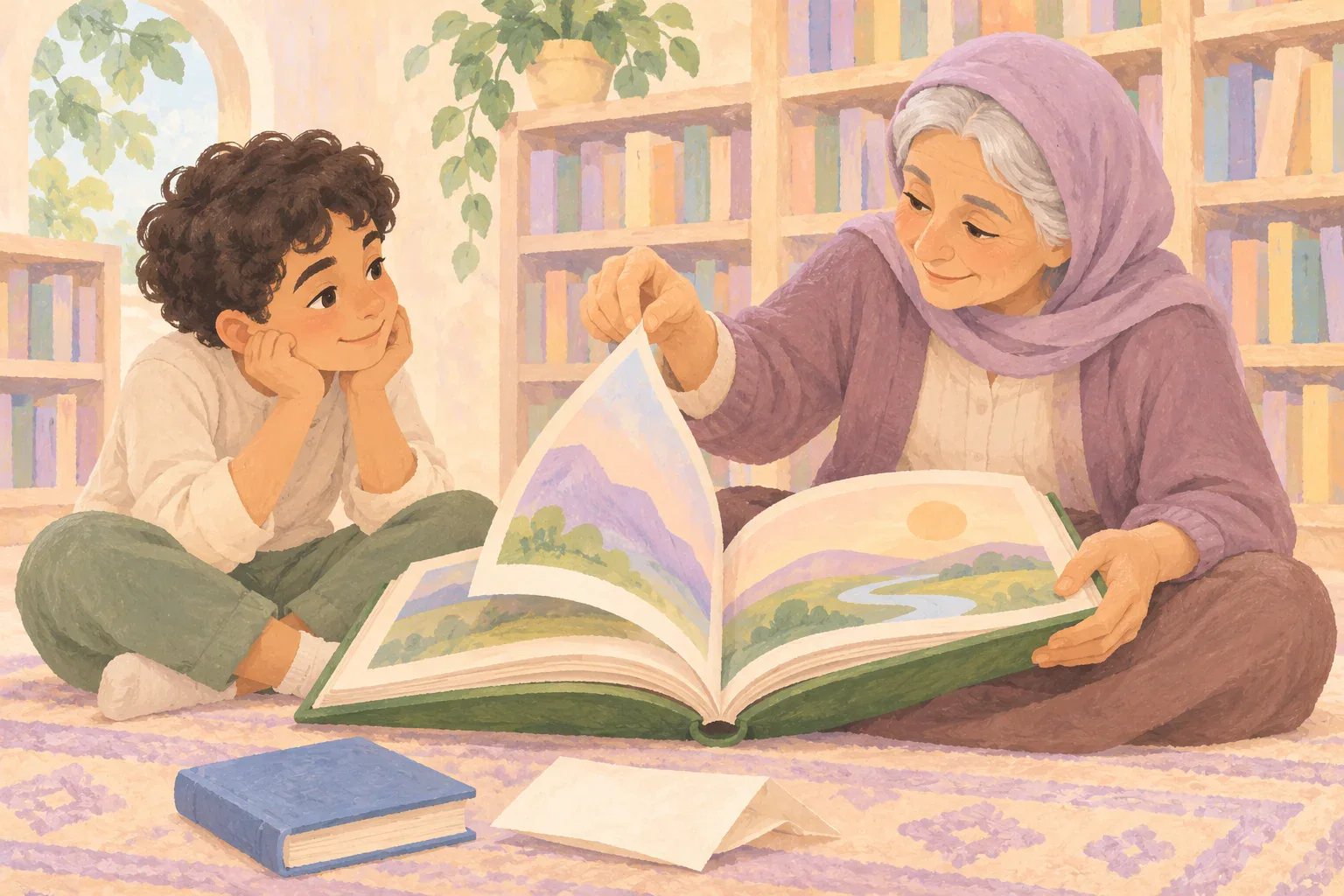
Your child picks up a picture book, opens the cover and says, “They printed this backwards.” Before turning it around, check: the book may be arranged for a writing system read from right to left.
For children aged 6–12, this is a chance to discover that the habits they use for one book are not rules for every book. You can explore the cover, pages and writing together without pretending to read a language you do not know.
Begin with “different from the books we use”
Try: “This may be the beginning. Let’s find out how readers use this book.” That keeps the question open. If the book belongs to a friend, ask before handling it or turning pages. A library copy can be a less pressured place to investigate.
New College Oxford’s library exhibition shows a historical book whose opening chapter sits at what a reader used to Latin books might consider the back, following Hebrew reading practice. The example is a reminder that the end you expect is not always the beginning another reader expects.
Avoid calling the book wrong, strange or upside down. “I’m used to starting here” describes your experience without ranking someone else’s.
A language and a script are different things
A language is what people communicate in; a script is a set of written signs used to represent text. English commonly uses the Latin script. Arabic and Hebrew writing use different scripts, with their basic letters running from right to left.
The W3C’s explanation of scripts and languages makes an important distinction: writing direction belongs to the script being used. One language can be written in more than one script, and a script can be used for more than one language.
So do not identify every right-to-left page as Arabic, or assume that a child can read a book because of their name or family background. Check the book’s language information or ask someone who knows that edition.
A short answer to the original question might be: “The words on these pages follow a different direction, so the book may open differently too. It works for the people reading it.”
Try a ten-minute book investigation
You need one age-appropriate book in a script unfamiliar to your child, a familiar book for comparison, paper and a pencil. Borrow rather than buy if possible. Ask a librarian or a willing, knowledgeable reader to confirm the unfamiliar book’s language and where its text begins. If you cannot confirm that yet, keep it as a question.
Use an ordinary children’s book rather than a fragile manuscript, sacred text or someone’s private notebook. Put both books on a clean, stable surface. No drawing or sticky labels belong on borrowed pages.
- Look for the title. Find the cover and title page with help. Say what you can establish: “The catalogue identifies this as a story in Hebrew.” Do not guess the title’s pronunciation.
- Find where reading starts. Ask the knowledgeable reader to show the first line and its starting point. Your child can point just above it, without marking or dragging a pencil over the page.
- Follow one line. Watch the reader indicate the direction. Then compare it with one line in the familiar book. Pointing along a line is observation; it does not mean your child has decoded the words.
- Check the next page. Let the reader demonstrate how this particular book continues. Avoid forcing a cover or spine because you expected it to open the other way.
- Save one finding and one question. On separate paper, write or draw “We found…” and “We still wonder…”. Finish with the book’s story or pictures, rather than turning every page into a quiz.
If no reader is available, a reliable publisher’s preview or read-aloud can help an adult check the edition. Do not make up sounds to accompany unfamiliar writing. You can honestly say, “We can look at the pictures, but we cannot read these words yet.”
Notice more than the direction
Your child may notice that letters join together. The British Council’s Arabic education pack explains that Arabic letters follow joining rules and can look different depending on their position in a word. That is a feature of meaningful writing, not random decoration.
You do not need to copy letters to appreciate the book. If your child wants to learn to write a word, use accurate teaching material and guidance, including the word’s meaning and how it is formed. Avoid asking them to invent marks and label the result “Arabic” or “Hebrew”. They can make an original abstract pattern, but it should be described as their own design.
Do not teach “everything goes the other way”. The Unicode Consortium’s writing-direction FAQ explains that Arabic and Hebrew text can include digits or other text flowing in a different direction. Some writing is also arranged vertically. A bilingual spread may therefore need closer guidance than one arrow across the whole page.
Make the investigation accessible
Ages 6–9: Keep the task to the cover, first line and one page turn. An adult reads instructions and confirms the information. Ask, “Where does this reader begin?” rather than testing whether the child remembers left and right on demand.
Ages 10–12: Invite the child to distinguish the language, script and layout information they have actually checked. They might compare a bilingual page with a single-language page and notice why one simple rule does not explain every element.
Offer a magnified page, verbal description, comfortable book support or the child’s usual communication system. A child can direct an adult to turn the page instead of doing it physically. Do not add raised marks or adaptations to a borrowed book without permission.
Let the book become an ordinary book again
Ask what the child is interested in next: the story, an illustration, the language or another book. They do not have to produce a fact sheet to show respect. If a friend shares a favourite story, that friend can enjoy it without becoming responsible for teaching the family a script.
For choosing future books, see our guide to multilingual family books. If curiosity turns into mockery, our guide to stopping language-based teasing addresses the behaviour separately.
A useful closing question is, “What did we check instead of assuming?” Perhaps it was the first page, the language label or the reader’s own explanation. The discovery is modest and valuable: unfamiliar print still carries meaning, and our usual way of opening a book is one convention among others.
Sources and further reading
- W3C Internationalization: scripts, languages and writing direction
- Unicode Consortium: writing direction and mixed-direction text
- New College Oxford Library: an example of a book arranged for Hebrew reading
- British Council: Arabic writing features
Read our editorial policy and review methodology.