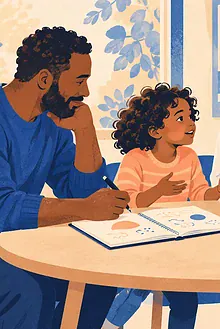
Children learn what gender means long before adults give them a formal lesson. They notice who cooks, who remembers appointments, who repairs things, who comforts tears and whose work is treated as important. A father can challenge limiting stereotypes through hundreds of ordinary choices—not by performing one “helpful” task, but by owning an equal share of family life.
Move from helping to shared responsibility
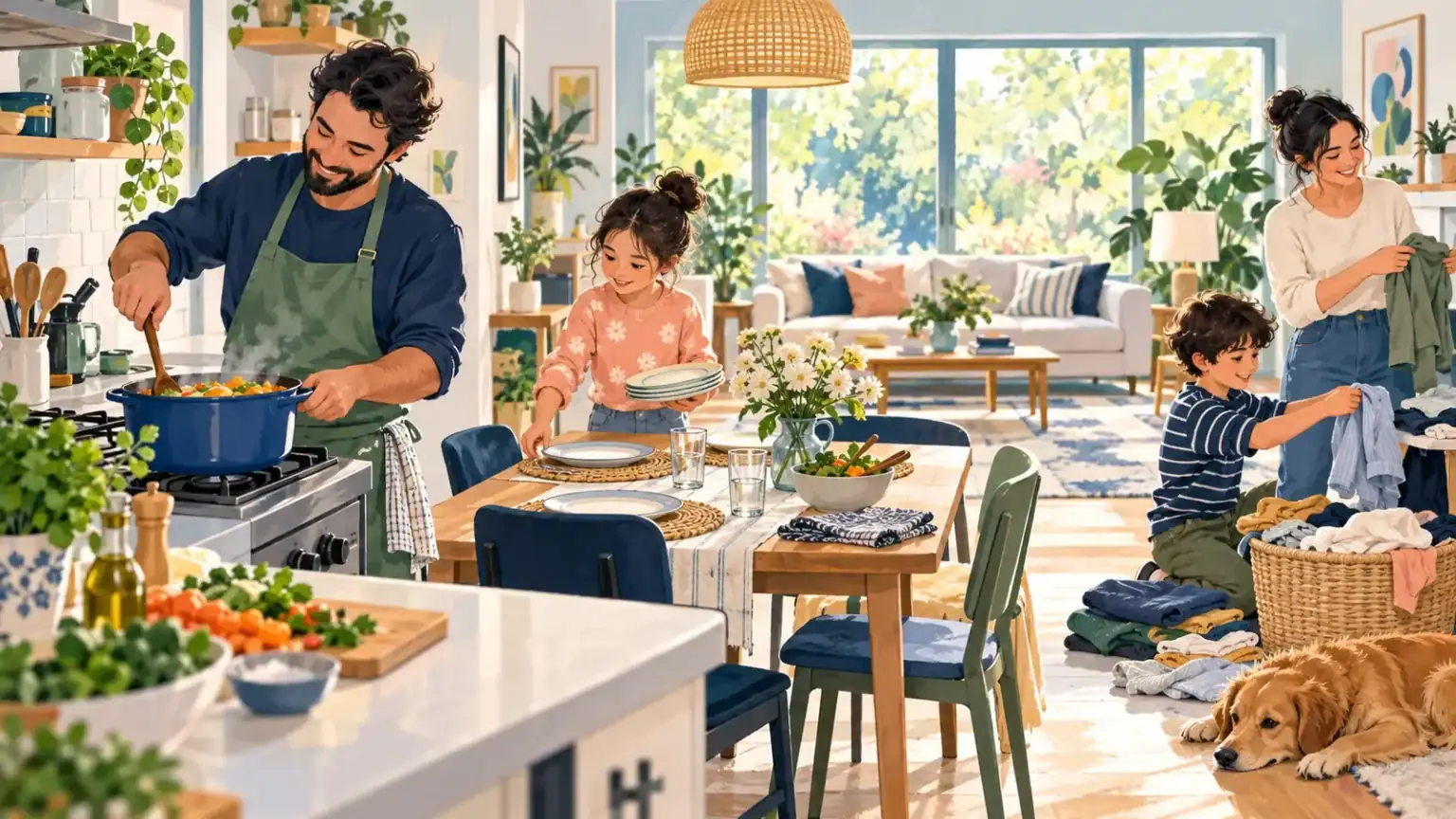
“Helping” can imply that care work belongs to someone else. Take full responsibility for recurring tasks: plan and cook meals on set days, manage school messages, book appointments, wash uniforms or lead bedtime. Full responsibility includes noticing, planning and finishing, not waiting for instructions.
Make the invisible work visible without turning it into a scorecard. Adults can list weekly tasks and divide them according to time, capacity and preference. Revisit the plan when work schedules or health needs change.
Give children chores by ability, not gender
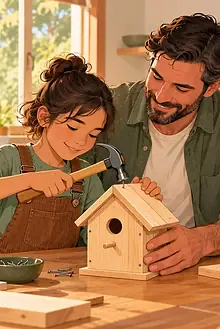
Every child can learn care, practical skills and contribution. Rotate tasks so all children practise cooking, tidying, basic repairs, caring for younger family members safely and managing money. Adjust the task for age and disability, but do not assume a daughter should serve or a son cannot nurture.
UNICEF advises equal participation in school, play and household chores and highlights fathers’ cooking, cleaning and caregiving as powerful role modelling. Children absorb the pattern they live with.
Audit the language in your home
Replace “man up,” “boys don’t cry,” “that’s for girls” and comments that value girls mainly for appearance. Try specific, human praise: “You stayed with a difficult problem,” “That was kind,” or “You asked before touching.” Welcome the full range of emotions in every child.
When a relative or friend makes a stereotype, a brief correction is often enough: “In our family, everyone can learn that,” or “Crying tells us something matters.” The goal is not a public argument; it is making the family value audible.
Share access to time, space and opportunity
Check who gets uninterrupted study time, sports fees, transport, technology and one-to-one attention. Equal treatment does not always mean identical treatment; one child may need an accommodation or extra support. It does mean gender should not decide whose ambition is funded or whose needs wait.
Invite every child into varied play: construction, stories, art, sport, dolls, nature and cooking. Follow interest instead of policing whether an activity is masculine or feminine.
Let children see men care
Comfort a child, attend health visits, know teachers’ names and check on relatives. Talk about consent and personal boundaries in everyday moments. When you make a mistake, apologise plainly. These acts show that care, competence and accountability belong to men too.
For practical involvement beyond the home, Stay Close to Your Child When Work Takes You Away offers ways to remain present even with difficult schedules.
Equality also shapes how adults set limits. Positive Discipline for Dads shows how to hold the same respectful standards without fear or shame.
Talk about what children observe
Ask open questions about books, advertisements or family routines: “Who gets to lead in this story?” “What jobs are missing?” “Would this rule be fair if the characters were different?” Listen before correcting. Children may repeat a stereotype while testing an idea, not declaring a permanent belief.
If a child challenges your behaviour—“Why does Mum always pack the bags?”—resist defensiveness. Say, “You noticed something important. We can change that.” Then change the pattern.
Make equality sustainable
Perfection is not the standard. Families have constraints, traditions and uneven workloads. Pick two visible shifts and keep them: perhaps Dad owns school communication and three dinners each week; perhaps chores rotate monthly. Review with the family. Children believe repeated practice more than a slogan.
Gender equality at home gives children more room to become themselves. It also builds a family culture where contribution, emotion and leadership are shared rather than assigned.