- Work out which part needs support
- Choose a book you can both enjoy
- Prepare one small piece, without setting yourself homework
- Have a plan for the moment you get stuck
- Keep corrections kind on both sides
- Ask nursery or school for a usable arrangement
- Find support that belongs to you
- Sources and further reading
By EdCaptain editorial desk · Published
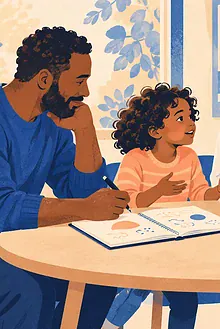
Your child brings you a book. You want to say yes, but you are already worrying about the words: losing your place, getting stuck or hearing “That’s not what it says.” It can be tempting to let someone else do every story.
You can keep a place in story time while finding support for the parts that are difficult. These suggestions are for dads sharing books with children aged 3–5. They are also useful to other caregivers. The aim is an enjoyable time together, not a public demonstration of your reading.
Work out which part needs support
Try naming the difficulty privately and specifically. Is the print too small? Do unfamiliar words slow you down? Is reading in this language harder than speaking it? Can you read comfortably alone but feel tense with an audience? More than one thing may be happening.
That answer helps you choose the next step. Larger print will not solve an unfamiliar language; practising a few words will not make a poorly lit page easier to see. You do not need to explain your whole history to ask a librarian for a book with clear pictures and short passages.
A reading difficulty is not a measure of your care for your child. You can seek help for yourself and share a story this evening. Neither has to wait for the other.
Choose a book you can both enjoy
Start with something that interests your child and feels manageable to you. Borrow before buying where possible. Look through it yourself: a thin book can still contain difficult vocabulary, tiny lettering or a complicated layout. Ask for a familiar subject, clear print and a short amount of text on each page.
If you prefer, begin with a wordless book or a picture-rich book you can discuss. The Department for Education’s early-years guidance includes talking about pictures, anticipating events and letting children describe what they think is happening. Shared book time can include these conversations.
Our wordless-book guide explains that option in detail. Use it as one route into stories, rather than a rule that you must avoid printed words forever. Let your child choose between two books you are comfortable sharing.
Prepare one small piece, without setting yourself homework
Before you sit together, glance through the pages you plan to share. Choose a natural stopping place. If one word worries you, ask a trusted adult to say it, or listen to an authorised audio version if your library provides one. You do not need to rehearse an entire book.
An audio version can also be part of the shared session. Pause it when either of you wants to look or talk; there is no requirement to keep pace with the recording. Use a familiar device you control, preview the content and avoid leaving your preschooler to navigate an app or its advertising.
If another adult helps you prepare, be specific: “Can we look at these two sentences together? I want to share this part myself.” Support can help you stay involved instead of quietly handing over the whole routine.
Have a plan for the moment you get stuck
You do not have to disguise every hesitation. A calm response could be:
- Pause: “I’m going to look at that word again.”
- Choose: take another look, check the audio or say, “I’ll ask someone about that word.”
- Reconnect: return to what is happening in the book, or stop at the agreed place.
Save the Children’s advice for adults who lack reading confidence reassures parents that reading slowly and acknowledging a tricky word are acceptable. You do not need theatrical voices or speed to make time for a story.
If you switch to telling your own version from the pictures, make that clear: “Now I’m making up a story about this picture.” That is different from pretending you have read the printed sentence. If your child knows a word, you can welcome their contribution without making them responsible for teaching or rescuing you.
For a child who communicates without speech, leave room for pointing, gestures or their usual communication system. Offer a comment and wait rather than asking repeated questions. A quiet look at a favourite picture can be enough.
Keep corrections kind on both sides
A preschooler may notice a changed word or insist on a familiar version. Try, “Thanks for noticing. Let’s look,” or “You remember that part.” If they laugh at a mistake, keep the boundary simple: “We can help each other. We don’t make fun of someone finding a word difficult.”
Avoid calling yourself stupid or predicting that your child will have the same difficulties. You can say, “Reading some words takes me longer.” You choose how much to share; your child does not need to hear painful details of your school experiences during their story.
Ask nursery or school for a usable arrangement
If a reading record or take-home book feels hard to manage, speak privately with the educator. For a child who has school reading practice, ask which task they want you to support and request a demonstration rather than guessing the teaching method.
Try: “I want to help, but reading the instructions is difficult for me. Could you explain the task and show me an example? Is there another way I can report what we did?” Keep picture-based storytelling separate from any specific decoding practice the educator has assigned. For families navigating different languages, our guide to using your home language offers further options.
Find support that belongs to you
The National Literacy Trust’s adult-literacy page signposts UK routes including adult education colleges, libraries and reading-support organisations. Ask about local eligibility, cost, privacy and the format before joining. Elsewhere, a local library or adult-learning service may help you find an equivalent.
Choose a goal that matters to you, whether that is reading a school message, enjoying a book or feeling more comfortable with everyday print. Your child’s story time does not have to become your literacy lesson. Tonight, you can choose a manageable page, sit together and see what catches their attention.
Sources and further reading
- Save the Children: Reading with your child
- Department for Education: Reading comprehension in early years
- National Literacy Trust: Adult literacy