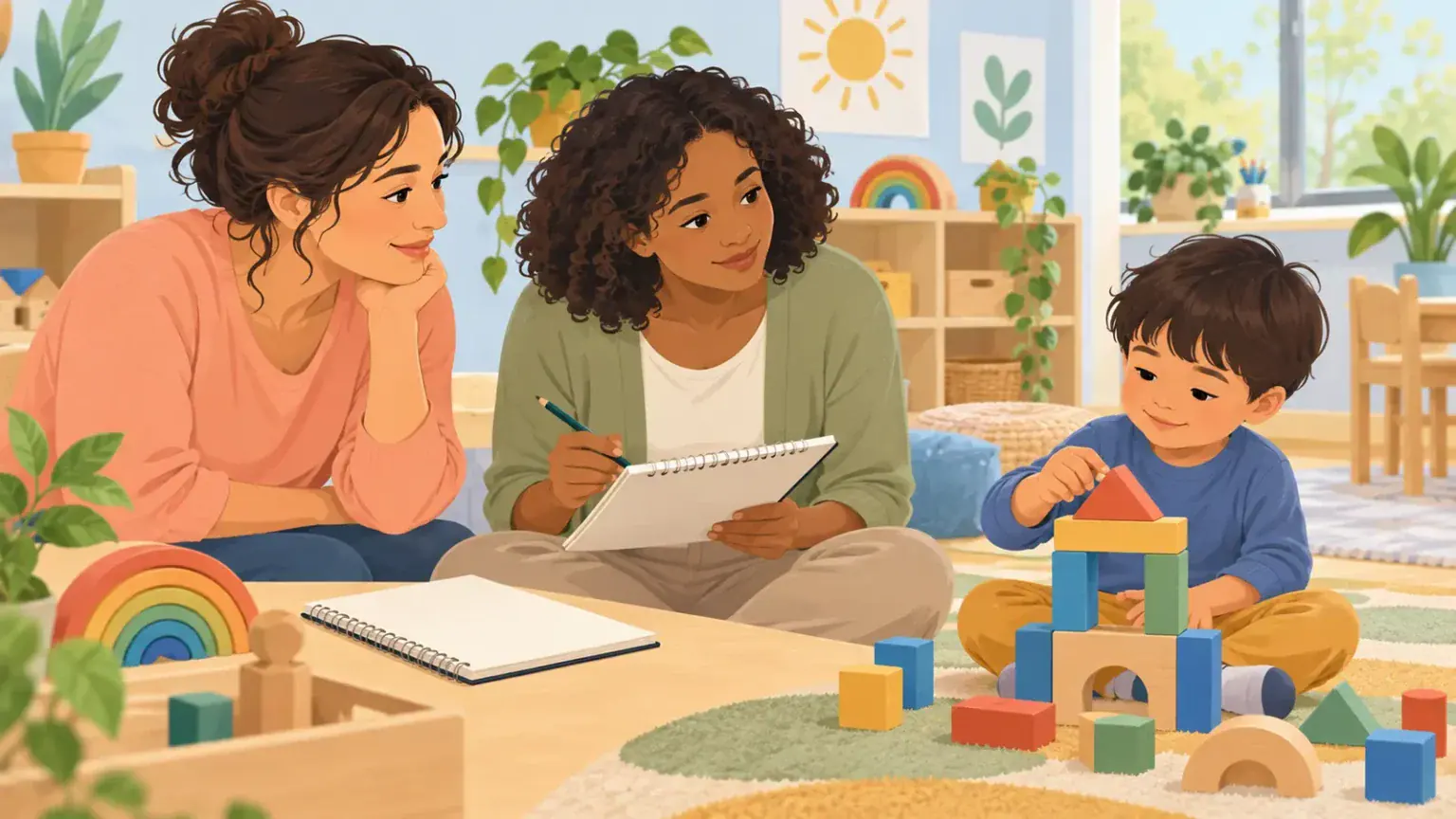
It can be unsettling when nursery or school raises a concern about communication, attention, movement, play or learning that you have not noticed at home. Different observations do not automatically mean that someone is wrong. Children face different demands in each setting: group noise, transitions, unfamiliar language, longer instructions, peer negotiation and less one-to-one support.
Ask for examples, not labels
Begin with curiosity: “Can you describe two recent situations?” Useful details include what happened before, what the child did, how long it lasted, how often it occurs, what peers were expected to do and what support helped. “Struggles socially” is broad. “At free play, she watches other children but does not join unless an adult gives her a role” is something adults can compare.
Ask about strengths and exceptions too. When does the child participate comfortably? Which adults, rooms, group sizes or activities make a difference? This keeps the discussion balanced and may reveal an environmental adjustment that can start now.
Share home observations with the same precision
Rather than saying “He never does that here,” explain the home context: “At home he follows two-step directions when we are face to face, but I usually get his attention first and the room is quiet.” That difference may explain why school looks harder. If the concern relates to language, describe every language the child hears and uses and with whom.
Keep a brief two-week record across routines. Avoid testing the child repeatedly or prompting until they perform. The goal is to see the ordinary pattern. Milestones are not a race, and comparison with one classmate is not an assessment.
Agree on a shared observation plan
- Name one or two behaviours to watch in both settings.
- Use the same plain description.
- Try a small support, such as shorter instructions or a visual routine.
- Record whether it changes participation.
- Set a date to review, rather than leaving the concern open-ended.
If appropriate, ask the child in simple, non-leading language: “What is easy at nursery?” and “When is it hard to know what to do?” Do not question them as if they must prove one adult’s account.
Decide what happens next
The next step may be continued monitoring, a meeting with the setting’s support lead, a formal developmental screen, a hearing or vision check, or discussion with a health professional. Ask what the setting can provide now and what needs consent. Screening is not the same as diagnosis; the guide to late talking and language concerns illustrates why hearing, context and communication strengths all matter.
Bring concrete records to any appointment. The CDC encourages caregivers to share specific concerns and keep notes, although referral routes vary by country. If you disagree with the proposed plan, ask for the reasoning in writing and about the local review process. Respectful disagreement is possible.
Support the child without waiting for a label
Use the adjustments that help: predictable routines, extra processing time, a quieter place, choices, visual cues or a clear role in play. These are supportive strategies, not condition-specific treatment. Keep enjoyable time together that is not observation or practice.
If the child becomes distressed about school, listen before problem-solving. Ask the setting about bullying, sensory load, learning demands and relationships rather than assuming one explanation. The guide to asking for help with learning difficulties offers further ways to organise a school conversation.
Act promptly for urgent changes
Contact a health professional promptly if the child loses a skill they previously used or develops new weakness, seizures, breathing or swallowing difficulty, or another serious change. Use local emergency services for immediate danger. Differences between home and school are useful information, but they should not delay urgent care.