Parents often hear the words monitoring, screening and assessment as if they mean the same thing. They are connected, but each answers a different question. Knowing the difference can make appointments less confusing and help families understand why one step may lead to another.
Monitoring: noticing development over time
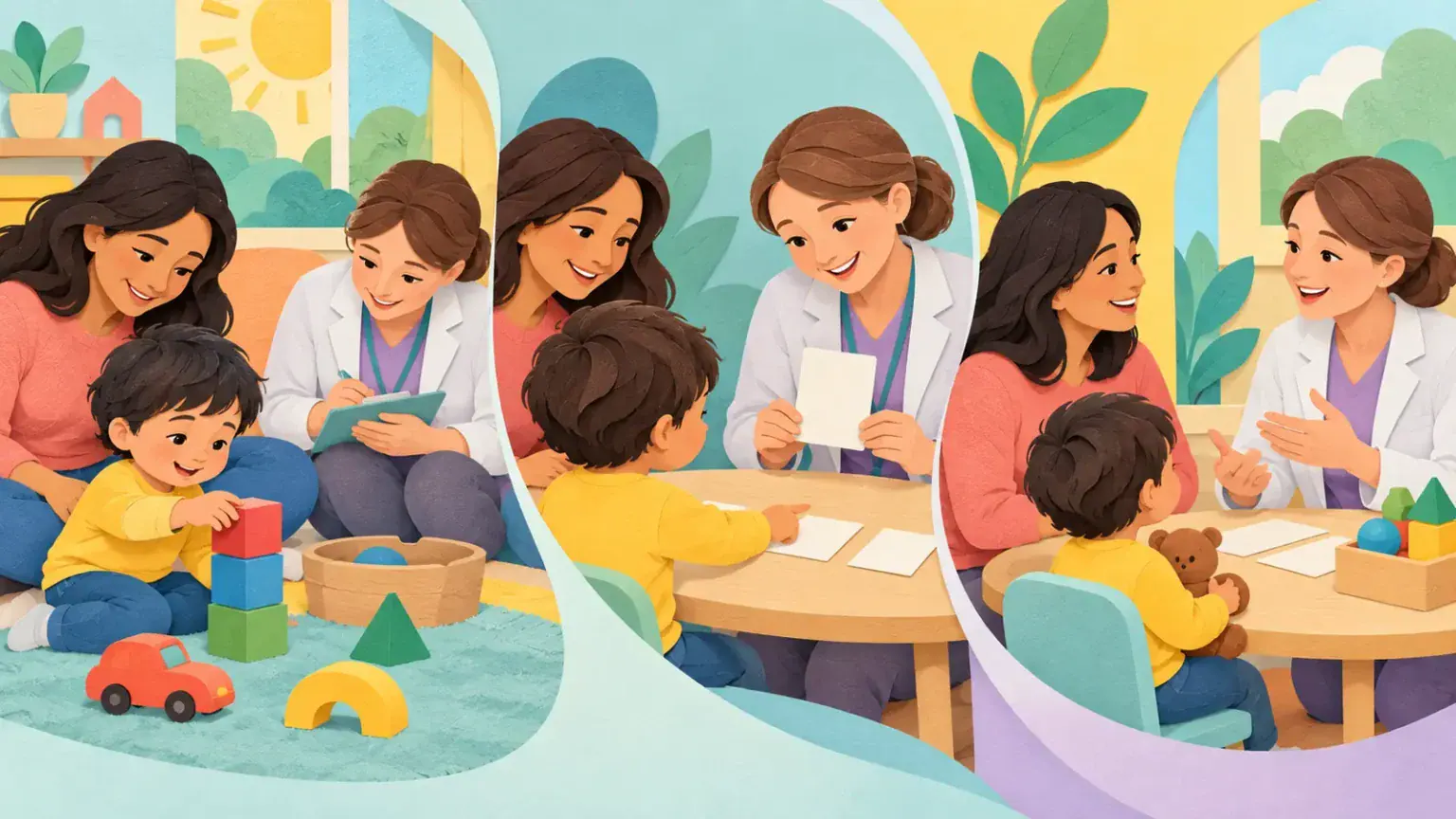
Developmental monitoring is the ongoing process of watching how a child plays, learns, communicates, moves and manages everyday life. Parents, caregivers, early-years staff, teachers and health professionals all contribute. It happens during ordinary routines and repeated contacts rather than in one special test.
Monitoring includes strengths and variation. A parent might notice that a toddler uses gestures confidently but few spoken words, or that a preschooler manages dressing at home but finds group transitions difficult. Milestone checklists can prompt observation, but they are not a diagnosis or a pass-fail exam. See why developmental milestones are not a race.
Screening: a structured check
Developmental screening uses a formal questionnaire or tool designed to identify children who may benefit from closer evaluation. It may involve parent answers, professional observation or simple activities. A screening result can indicate that development appears on track, that monitoring should continue or that further assessment is worth considering.
A screen does not by itself prove that a child has or does not have a particular condition. Results can be influenced by language, health, familiarity with the task and context. The professional should interpret the tool, explain its limits and consider family and setting observations.
The CDC describes routine screening schedules used in the United States and also recommends screening when concerns arise. Other countries and services use different schedules and tools, so ask your local provider what applies.
Assessment: building a fuller picture
A developmental assessment—or evaluation, depending on the service—is a more detailed process. It may include history, play or task observation, standardised measures, hearing or vision checks, physical examination, school or nursery information and input from several professions. The exact team depends on the question and local system.
Assessment may explore abilities, support needs and possible explanations. It does not always produce a diagnosis at the first visit. Sometimes the result is a plan to observe over time, gather information from another setting or offer support while questions remain.
How the steps can connect
A parent notices a pattern through monitoring. A professional uses a screening tool. If the result and wider observations suggest concern, the child may be referred for fuller assessment. But pathways are not always linear: a strong concern, loss of a previously used skill or an urgent health change may require prompt evaluation without waiting for routine screening.
Questions families can ask
- Is this conversation monitoring, a formal screen or part of an assessment?
- Which tool is being used, and what can it tell us?
- How were language, disability, culture and the child’s comfort considered?
- What information came from home, nursery or school?
- What happens next, by when and who is responsible?
- What support can begin while we wait?
Bring the kind of concrete examples described in the late-talking guide when communication is a concern. Describe what the child does across routines, not only a milestone age.
A result is not the whole child
Scores and reports should guide understanding and support, not reduce a child to a category. Ask for findings in plain language and for strengths to be recorded alongside needs. If the result does not fit what you see, explain the difference and ask how information from more than one context can be included.
If you remain concerned after reassurance, keep notes and follow up. Seek urgent medical help for immediate danger, serious illness, new weakness, seizures, breathing or swallowing difficulty, or sudden loss of skills. Routine monitoring and screening are not emergency care.