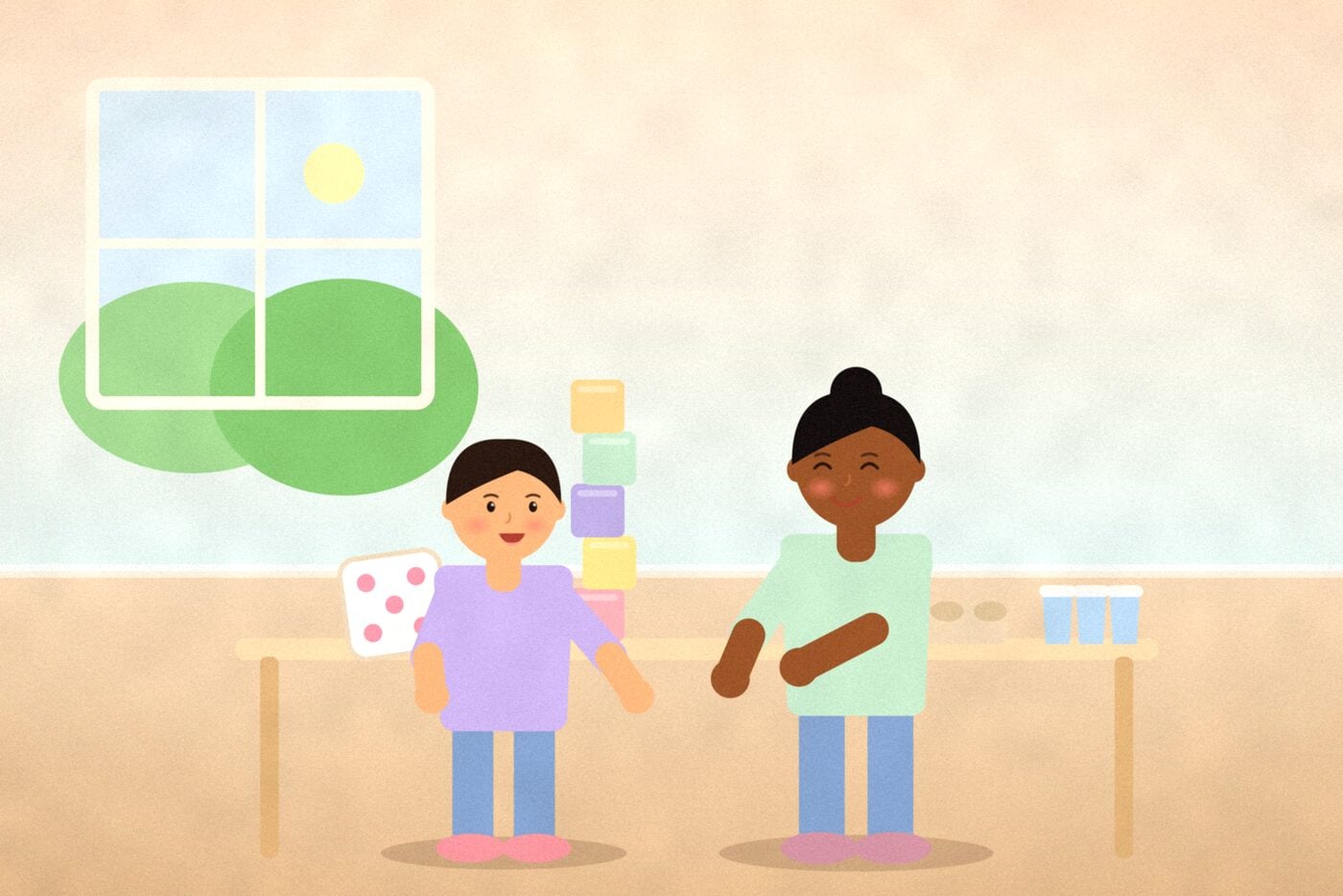
Age guide: 3 to 8 years. Choose the games that match your child’s counting.
When the weather keeps you in, a table, a few household items and a die can hold a whole afternoon of number games. Each of these builds on the same idea: numbers describe how many, and you can check by counting.
A note on small items
Counters such as buttons or beads are a choking risk for children under three. Use large objects like wooden blocks or bottle tops that do not fit through a toilet roll tube, and supervise throughout.
1. A shared tower
You need: blocks and a large die.
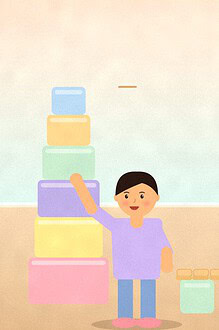
Take turns rolling. After each roll, count out that many blocks and add them to a shared tower. Finish when the blocks run out or the tower gets too tall. Notice whether your child can agree with a sibling on what to build.
2. Numbers in order
You need: number cards or magnets from 1 to 10 and a board or tray.
Give each player a number. The person with 1 places it, then says it aloud. The next person finds 2 and adds it, and so on until they run out. Mix up the cards and see if they can order them again.
3. Grab bag
You need: slips of paper numbered 1 to 10 in a bag, and a pile of counters.
Your child pulls out a slip, says the number and counts out that many counters into a pile beside it. Repeat until every slip is used. To make it harder, ask them to line up the piles from smallest to largest.
4. Egg carton shake
You need: an egg carton, a marker and one large bead or button.
Write the numbers 1 to 12 inside the cups. Put the item in, close the lid and tape it shut. Shake! Open the carton and read the number the item landed on. Count out that number of fingers or blocks. Keep a tally of the results. With two items, add the two numbers.
5. Roll through the tunnels
You need: large paper, tape and a small ball.
Fold card into four tunnels with different numbers above each. Roll the ball through a tunnel and score the number above it. Add your scores. To avoid a winner, work together to reach ten.
6. Bottle bowling
You need: ten empty plastic bottles, a ball and slips of paper with challenges.
Write a challenge on each slip and roll one up inside each bottle: “How many bottles are there?” “If I take away two, how many are left?” “Make a circle with the bottles.” Set up the bottles as pins. Your child rolls the ball, picks a bottle that fell and does what the slip says. Reset and repeat.
7. Number hunt
You need: cards numbered 1 to 10.
Pick a card and find that many of something: three spoons, five cushions. Count them aloud.
8. Do we have enough?
You need: two sets of things that go together, like cups and saucers, or people and hats.
Put out both sets and ask, “Are there enough?” Then ask, “How can we find out?” Let your child match one to one. If they do not match, ask, “What is different?” and “What could we do to make them match?” They might add some or take some away.
Closing
If a game becomes frustrating, stop. For more on getting comfortable with numbers, see fingers are tools in maths.