“The bird sings.” Change one bird to two birds and something else has to change: “The birds sing.” This card game lets children move the words around and hear how a sentence works.
Set up a small word bank
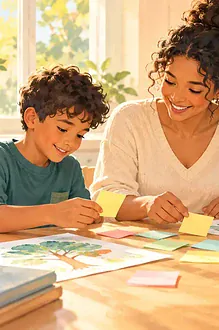
Allow 15–20 minutes. Use paper cards and a thick pen, or write on a shared screen. Start with children who can read short sentences; an adult can read the cards aloud for anyone who prefers listening. You can play with one child or a small group.
- Subjects: the bird, the birds, my friend, my friends.
- Verbs: sings, sing, runs, run.
- Optional endings: in the garden, after lunch, to the gate.
Keep the first round in the present simple. Mixing every kind of verb and subject at once makes the puzzle much harder to see.
Build, change and listen
- Choose “the bird” and invite your child to select “sings” or “sing”. Read the whole sentence together.
- Add an ending if you want one: “The bird sings in the garden.” An ending is optional; “The bird sings” is already a complete sentence.
- Swap in “the birds”. Ask what needs to happen to the verb. Try both cards and read them aloud.
- Make a new pair with “my friend” and “my friends”. Let your child explain the pattern in their own words.
- Take turns being the sentence builder and the person who checks it. Discuss a mismatch without scoring or embarrassment.
The pattern to notice
With these third-person present-simple examples, a singular subject takes “sings” or “runs”; a plural subject takes “sing” or “run”. Avoid teaching “singular always means add s”: “I sing” and “you sing” show why that shortcut does not work for every subject.
Keep “be” for a separate round: “The bird is small” and “The birds are small”. Other tenses and helping verbs have their own patterns, so introduce them when the first game feels familiar.
Make it easy to join in
Use large print, picture cues, spoken choices or a communication aid. Colour can help group the cards, but include another cue so colour is not the only way to tell them apart. There is no need to shake hands or move around the room to make a match.
Finish by choosing one sentence your child wants to illustrate. Ask which word changed and why. A handful of understood examples is a better stopping point than a long pile of rushed answers.