“My teacher hates me” can land like an alarm bell. Your child may be describing unfair treatment, a painful misunderstanding, a clash in communication styles or one bad day that now feels much bigger. The useful first move is neither to dismiss the claim nor to decide that the teacher is at fault. It is to slow the story down.
Your job is to make your child feel heard while you gather enough detail to help. That balance protects the relationship with your child and gives the school a fair chance to respond.
Start with the feeling, not the verdict
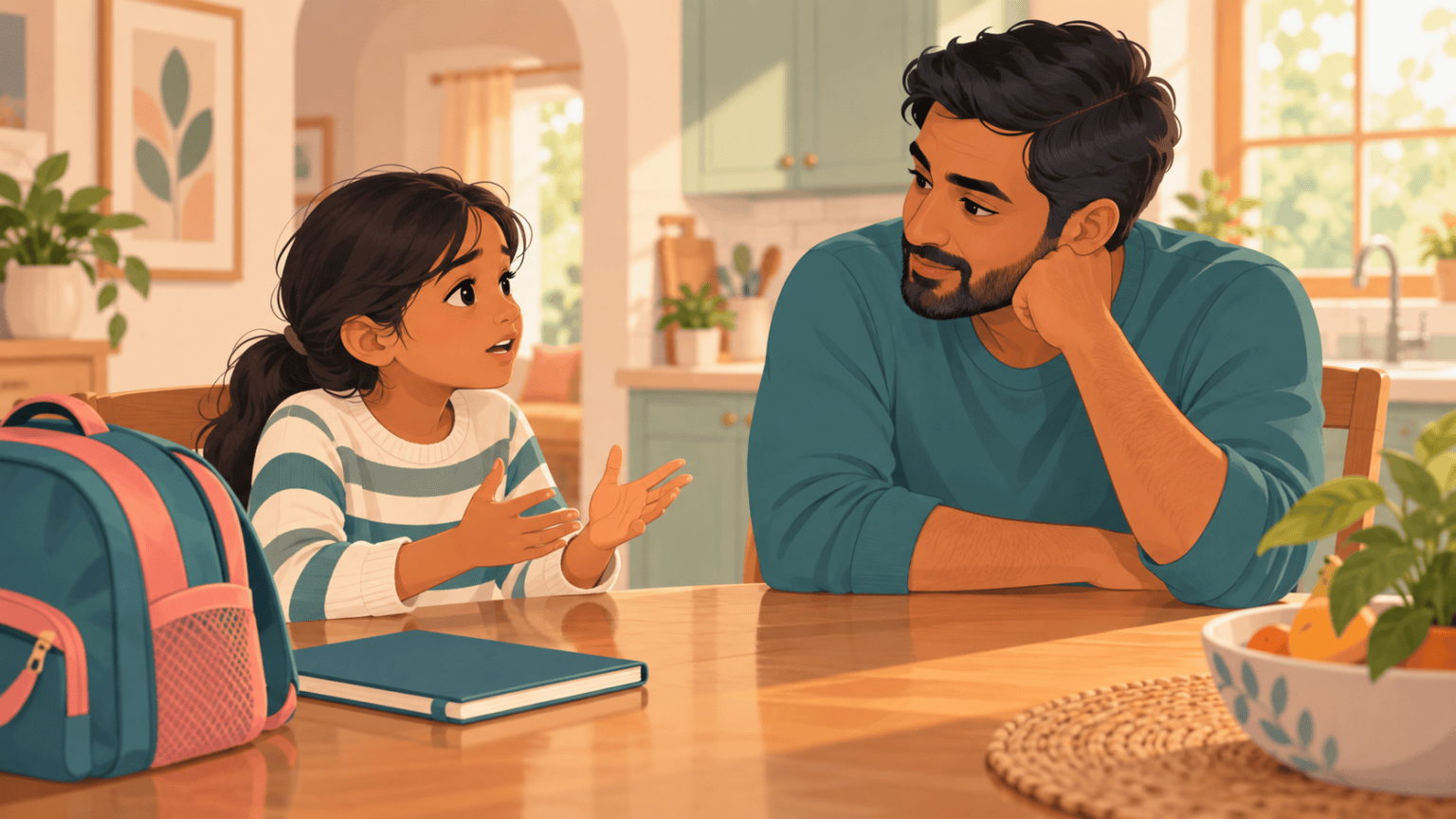
Try: “That sounds upsetting. Tell me what happened that made it feel as though your teacher doesn’t like you.” This validates the feeling without confirming a conclusion you cannot yet know. Avoid “That teacher would never do that” and “I’ll sort them out tomorrow.” Both can make later fact-finding harder.
If your child is flooded, feed them, let them decompress and return to the conversation. Some children talk more easily while drawing, walking or doing a simple job beside you.
Turn a global claim into a sequence
Ask short, neutral questions rather than conducting an interrogation:
- What happened just before the teacher spoke?
- What words do you remember?
- Who else was there?
- Has this happened once or more than once?
- What did you do next?
- What would have helped in that moment?
Listen for patterns. Is the friction limited to transitions, unfinished work, noise, one subject or a particular peer? A child who says “always” may mean “twice this week, and both times I felt embarrassed.” That does not make the feeling unimportant; it makes the problem more solvable.
Help your child try one safe next step
When the concern is ordinary friction rather than intimidation or harm, rehearse a sentence your child can use: “I wasn’t sure why I was moved. Could you explain it after class?” or “I want to do this correctly. Can you show me the first step?” Younger children may need you to contact the teacher first. Older students often benefit from choosing whether they want to speak, write a message or have you join them.
Do not require a child to confront an adult alone if they feel unsafe, fear retaliation or have reported humiliation, discriminatory language, threats, physical handling or sexualized conduct. Those concerns need prompt adult escalation through the school’s safeguarding or leadership route.
Contact the teacher with a problem-solving message
Keep the first message brief and specific: “Mina has come home upset after maths twice this week. She says she was corrected in front of the class and now believes you are angry with her. Could we compare what each of you has noticed and agree on a way forward?”
At the meeting, ask for examples, frequency and context. Share what your child reported without presenting it as proven fact. The American Academy of Pediatrics recommends approaching school problems as a partnership, agreeing on actions and setting a time to review progress. That same approach works across many school systems, although escalation routes differ.
A small plan might include private rather than public correction, a visual reminder, a check-in at the start of class, a different seat or a signal your child can use when confused. Write down who will do what and review it after one or two weeks.
If the accounts do not match
Different accounts do not automatically mean someone is lying. Adults and children can experience the same interaction differently. Say, “I hear that you both saw this differently. What change would help the next lesson go better?” Keep the focus on observable actions rather than whether someone “likes” someone else.
If the problem persists despite a clear plan, involve the relevant year adviser, counsellor, learning-support lead or principal. Bring dates and examples. If school distress is affecting sleep, eating, attendance or mood, consult an appropriate health professional as well.
What your child can learn from this
The goal is not to make every teacher-child relationship warm. It is to help your child expect respectful treatment, communicate concerns and seek support when a working relationship breaks down. You can say: “You do not have to feel close to every teacher. You do deserve to be safe, treated fairly and helped to learn.”
For related support, see preparing for a parent-teacher conversation, responding when a child avoids school and supporting executive skills.