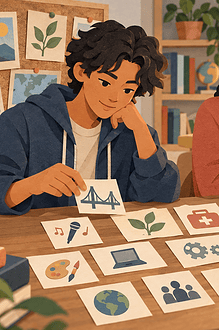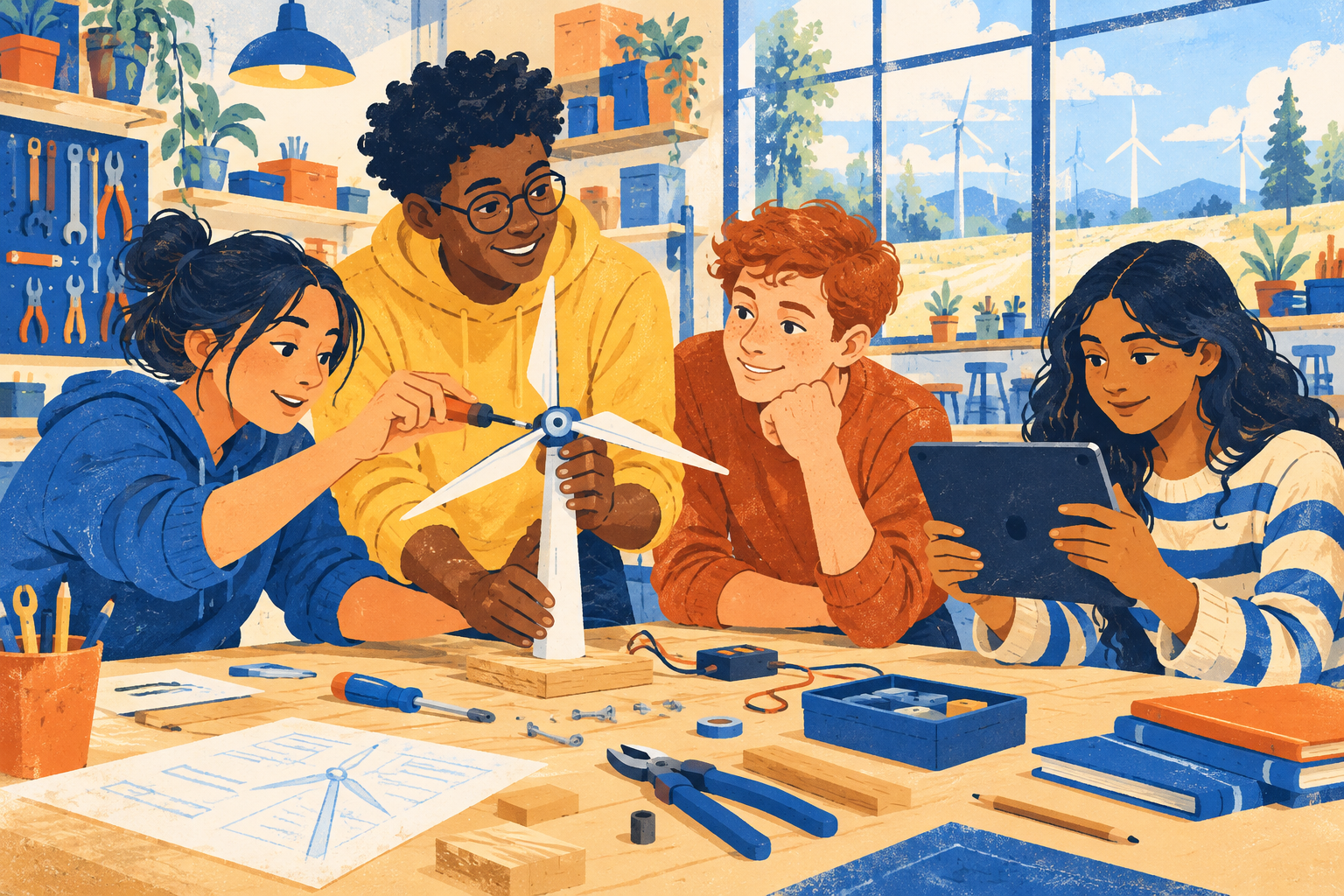
Parents hear two messages at once: prepare your teenager carefully, and accept that work is changing too quickly to predict. That tension can send families chasing lists of “future-proof jobs.” A better aim is a teenager who can learn, investigate and adjust when a role, tool or route changes.
- Build a skills portfolio, not just a subject list
- Teach career navigation as a repeatable cycle
- Use technology, but keep the human judgement
- Explore work beyond familiar family examples
- Keep several routes visible
- A monthly “future skills” check-in
- Replace certainty with readiness
- Sources and further reading
OECD career-readiness research emphasises three kinds of activity: thinking about working life, exploring possibilities and experiencing workplaces. None requires a family to predict the exact job market ten years from now. They require practice navigating uncertainty.
Build a skills portfolio, not just a subject list
Transferable skills become credible when your teen can point to evidence. “Communication” is vague; “explained our robotics design to younger students and revised it after questions” is useful. Help them collect short examples under four headings:
- Thinking: analysing information, solving problems, making decisions and checking assumptions;
- Working with people: listening, collaborating, resolving conflict and explaining ideas;
- Getting things done: planning, meeting deadlines, improving after feedback and using tools responsibly;
- Adapting: learning a new method, recovering from a mistake and transferring a skill to a new setting.
School projects, caring responsibilities, sport, creative work, part-time jobs and community activity can all provide evidence. Do not treat paid work as the only “real” experience.
Teach career navigation as a repeatable cycle
- Notice: What interests, values, needs and constraints matter now?
- Explore: Which roles, courses and routes might fit those ingredients?
- Test: What small experience could reveal the daily reality?
- Reflect: What did the teen learn about the work and themselves?
- Choose: What is the next sensible, reversible step?
This cycle still works if a particular technology or occupation changes. EdCaptain’s guide to making a hard decision can help when options carry different risks and benefits.
Use technology, but keep the human judgement
Teens should learn to use current tools—including AI—while checking outputs, protecting private information and understanding when a human expert is needed. Do not reduce “digital skill” to knowing one platform. Platforms change. The durable skill is learning a new tool, evaluating its result and applying it ethically.
Ask your teen to describe a tool in terms of the problem it helps solve. Then ask what could go wrong: inaccurate output, bias, privacy loss, over-reliance or exclusion. That produces more adaptable judgement than simply collecting app names.
Explore work beyond familiar family examples
Family networks are helpful but narrow. Use reliable job profiles, open days, school advisers, professional associations and conversations with people in varied roles. Look at daily tasks, conditions, entry routes and progression—not only job titles and salary headlines.
One informational conversation can include: “What has changed most in this work in five years?” and “Which skill remains useful even when the tools change?” A short placement can reveal more; use a clear, safe plan rather than arranging informal unsupervised access.
Keep several routes visible
A transferable skill can be built through university, vocational training, an apprenticeship, employment, community work or independent projects. Compare the fit of university, vocational and apprenticeship routes without assuming one has permanent higher status. Check local requirements and costs because systems differ.
A monthly “future skills” check-in
Once a month, ask three questions over a meal or walk:
- What did you learn to do this month that was difficult at first?
- Where did you use a skill in a new situation?
- What kind of work or problem are you curious to investigate next?
Keep it brief. The point is to notice growth, not turn home into a performance review. For language to describe strengths, use the I am, I have, I can framework.
Replace certainty with readiness
No course can guarantee a future job, and no parent can remove labour-market risk. You can help your teen leave school with evidence that they can learn, collaborate, solve real problems, ask good questions and revise a plan. Those abilities do not make a career effortless. They make change less paralysing.