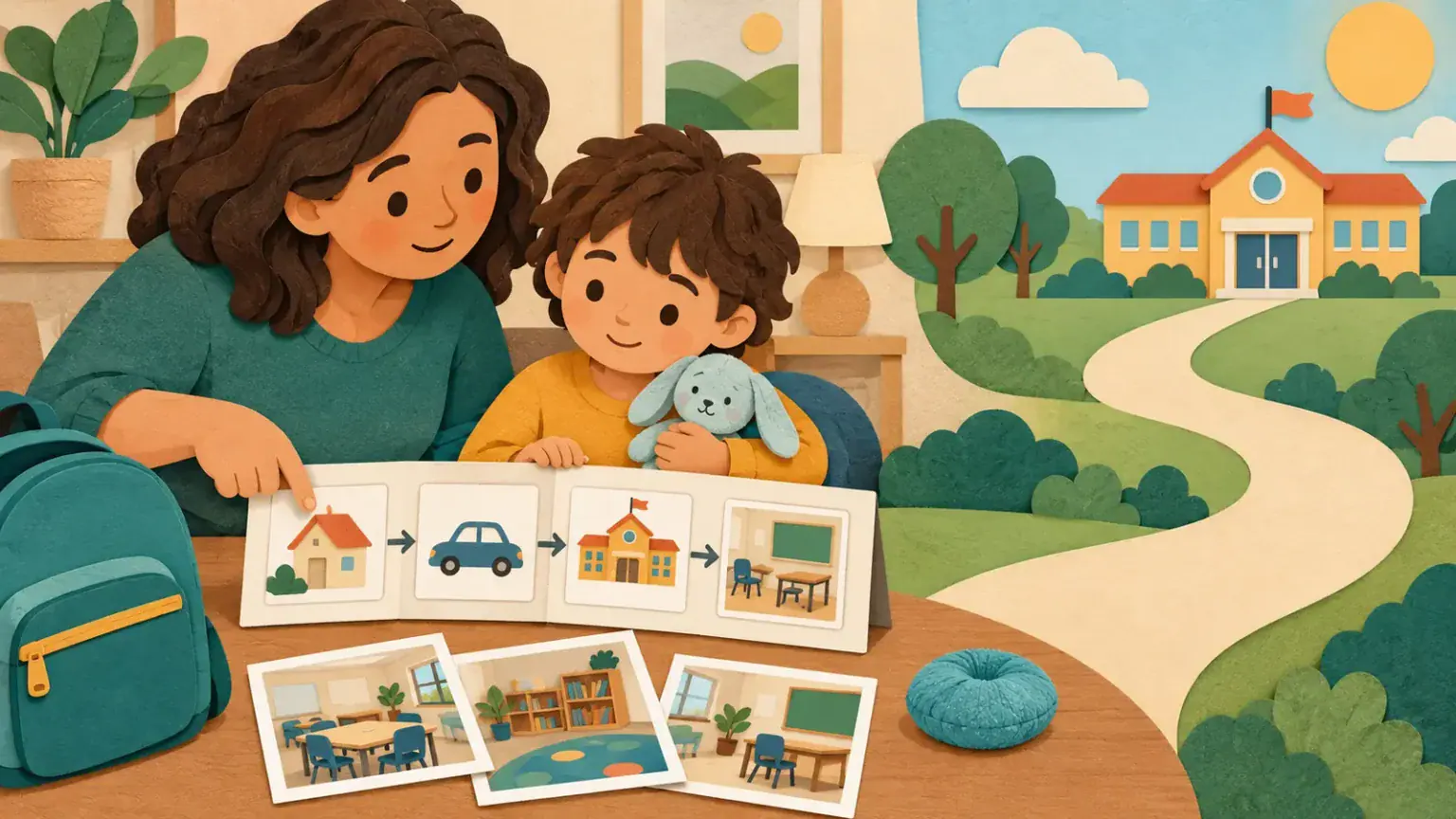
A change that looks small to an adult can ask a lot of an autistic child. Leaving the house by a different door, meeting a substitute teacher or ending a favourite activity may involve uncertainty, sensory differences and the loss of a carefully understood sequence. The goal is not to make a child tolerate every surprise without feeling. It is to make change more predictable, give them ways to communicate, and help their nervous system recover.
Start by finding the difficult part
“Transitions are hard” is useful information, but it is not yet a plan. Watch for the exact point where distress rises. Is the child absorbed in an activity? Do they need more processing time? Is the next place noisy or crowded? Are they unsure who will be there? A short note for several days can reveal patterns: what happened before, what the child did, what helped and how long recovery took.
Behaviour is communication. Crying, freezing, running away, repeating questions or refusing to move may mean “I do not understand,” “I am not ready,” or “this feels unsafe.” During high distress, use fewer words and focus on safety. Problem-solving works better later, when the child is regulated.
Build a transition plan the child can use
- Show what is happening now and next. Use two pictures, objects, written words or a phone note: “Shoes now; playground next.” Match the format to the child’s communication style.
- Give concrete warnings. “Five minutes” may be vague. Pair time with something visible: a timer, the end of one song, or “two more turns.” Avoid a long series of warnings if they increase anticipation.
- Make the ending clear. Photograph a work in progress, save the game, or put a bookmark in the book. A small closing ritual can show that the activity is paused rather than lost.
- Preview the next setting. Say who will be there, what the first step will be and where the child can take a break. For a new place, photos or a short visit may help.
- Offer limited choices. “Blue shoes or green shoes?” preserves control without changing the non-negotiable plan. Do not offer a choice when both answers are not genuinely possible.
For a bigger event—moving classroom, starting school or travelling—use a simple story or calendar over several days. Include what will stay the same as well as what will change. The National Autistic Society’s school guidance notes that transitions and unclear routines can be especially difficult and that tailored visual information, a trusted adult and sensory adjustments may help.
Prepare for the plan to change
A visual schedule should support flexibility, not promise that life will always follow a fixed script. Add a neutral “change” card and practise it during low-stakes moments: swap the order of two pleasant activities, show the change, and acknowledge it. You might say, “The park is closed. That is disappointing. The new plan is the library, then a snack.” Validation and clear information can sit together.
Create a small transition kit with whatever helps this child: headphones, a familiar object, a drink, a communication card or a quiet activity. A child who uses augmentative communication should have access to it during transitions. After a demanding change, schedule recovery time instead of immediately adding another task.
Adapt the support, not the expectation of dignity
Younger children may use photos or objects; readers may prefer a checklist; teenagers may want the plan in their own phone and a say in who is told. Some children need an adult to co-regulate beside them, while others need quiet space. Ask what helps and respect “no” whenever the situation is optional.
If transitions regularly lead to danger, school avoidance, severe sleep disruption or distress that limits daily life, speak with the child’s healthcare or education team. Check for pain, anxiety, communication barriers and sensory overload rather than assuming the child simply needs firmer discipline. The same observation-first approach is useful when exploring early autism patterns, considering an autism assessment, or supporting sensory needs.