Age guide: 3 to 8 years. Begin with two-step patterns.
A pattern is something that repeats in a way you can predict. Children can see patterns in colour, sound and movement, and they can feel patterns too. These four games ask children to follow, copy and invent patterns with their whole body. For a quieter version, see clap, tap, repeat.
Safety
Use soft ground or a clear indoor space. Games with moving balls need a bit of room and a gentle touch.
1. Spots in a line
Time: 5 to 10 minutes. You need: coloured paper or spots in three to five colours.
Give each child one spot. Ask one child of each colour to put theirs on the floor in a line and name the colour aloud. Read the line together: red, green, blue, yellow. Ask: “If we repeat the pattern, which colour comes next?” Invite a child to place the next spot, and so on. Try number cards or shapes for odd and even patterns.
2. The secret path
Time: 10 minutes. You need: 20 pieces of coloured paper in a grid and a start line.
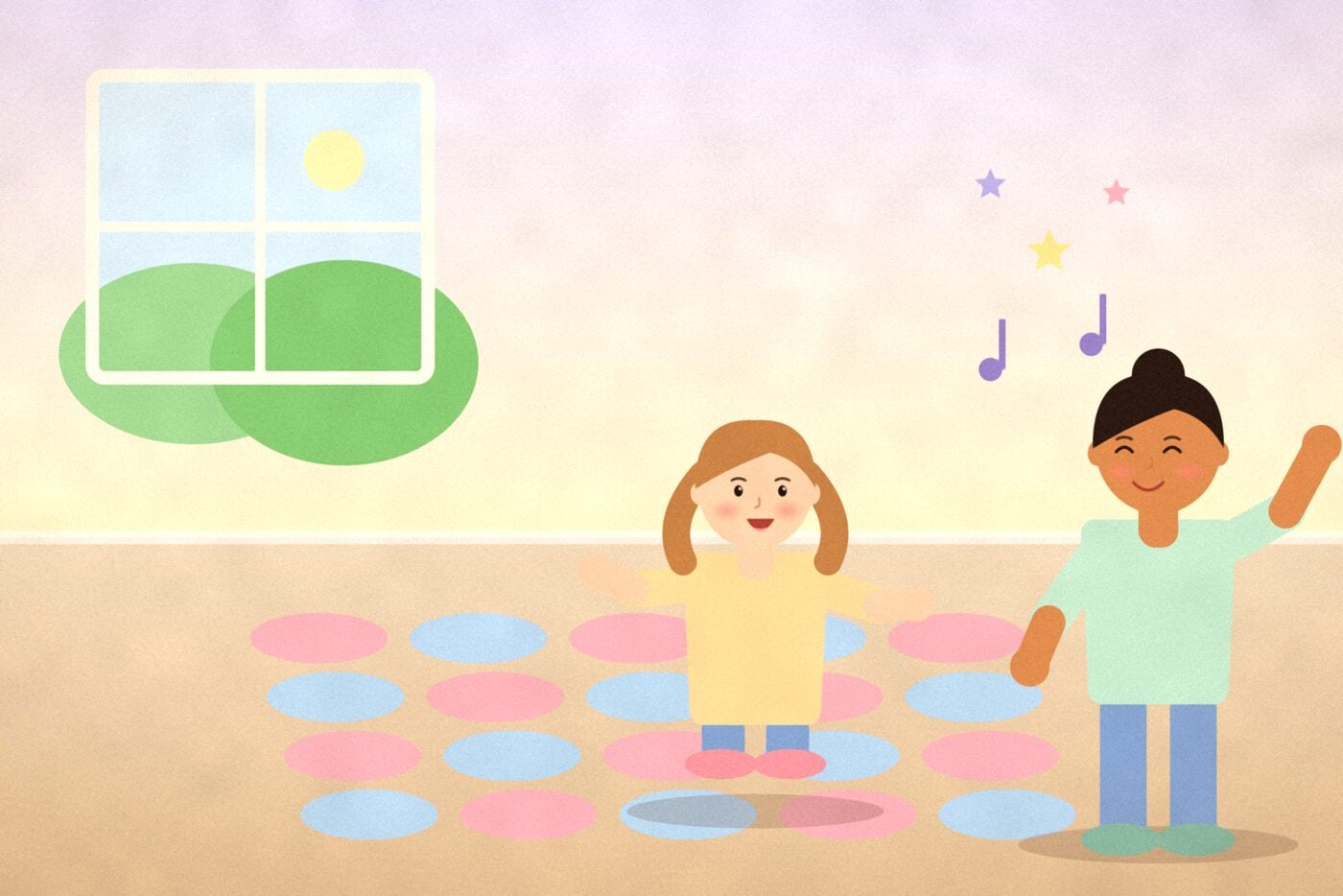
Lay the pieces in a grid on the floor, say four rows of five. Choose a pattern, such as “blue, red, blue, red”. One player at a time walks across stepping only on that pattern. If they step on a correct square, you make a “ding”. If not, make a buzzer sound and they must start again. When one child finds the path, others follow. For a harder game, do not tell them the pattern. They figure it out from the dings and buzzes. Try letters or numbers instead of colours.
3. Over, under, around
Time: 10 minutes. You need: a ball and teams of four to eight.
Line up in teams. The first player passes the ball back over their head. The second passes it between their legs to the person behind. Continue: over, under, over, under. The last person runs to the front and starts again. Once they know the pattern, ask them to say which move comes next. Later add a third move, around the side, to make over, under, around.
4. Pattern walk
Time: 10 minutes. You need: a start and finish line.
The first child chooses a pattern of movements to cross the room, for example big step, hop, little step, hop. They repeat it until they reach the finish. The next child copies it exactly. Let every child have a turn at inventing a pattern.
A pattern in everyday life
Point out patterns at home: stripes on a towel, the beat of a song, the sequence of morning routines. Ask what comes next.