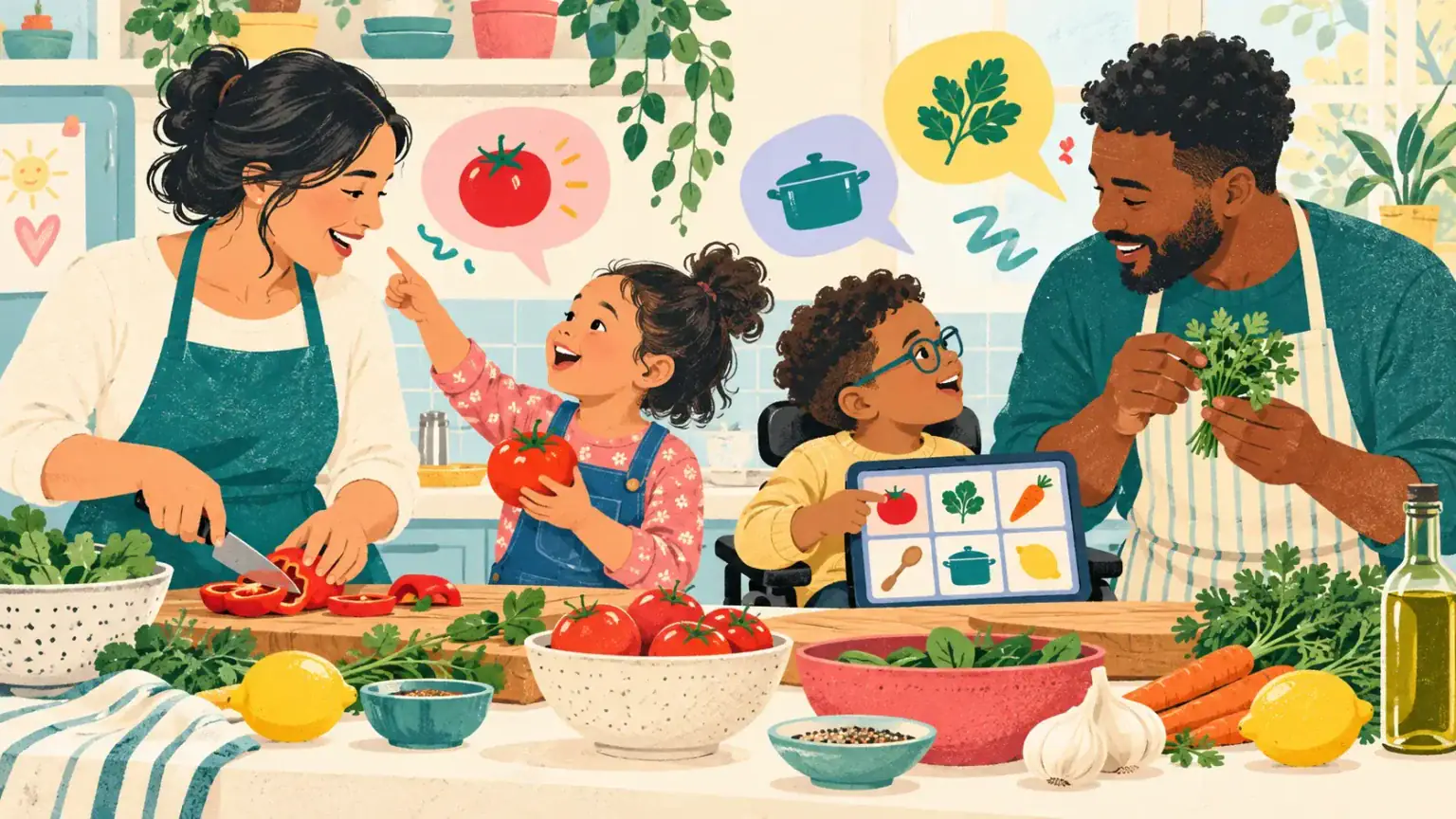
Vocabulary grows when words carry meaning inside a relationship. A child is more likely to remember “crisp,” “measure” or “predict” when the word helps them cook, solve a problem or share an idea. Families do not need to turn dinner into a lesson or correct every sentence. They can make ordinary talk a little richer and more responsive.
Follow the child’s attention
Notice what the child is looking at, doing or trying to express. Add language to that moment: “The peel is slippery,” “You balanced the block,” or “You expected the bus to come sooner.” A useful word is easier to learn when its meaning is visible or felt.
For babies and toddlers, respond to looks, gestures and sounds as turns in a conversation. Pause so the child can answer in their own way. For children who use signs, symbols or communication devices, acknowledge the message first and model additional language without demanding repetition.
Use the NOTICE–ADD–RETURN rhythm
- Notice the child’s message or interest.
- Add one word, detail or connection.
- Return the turn with a comment, choice or genuine question.
If a child says, “Big truck,” you might say, “A huge recycling truck is lifting the bin. Do you think it will be noisy?” This is expansion, not correction. The child hears a fuller model while their contribution remains respected.
Make routines more descriptive
Cooking: compare smooth and lumpy, sprinkle and pour, raw and cooked. Predict what heat will change.
Travel: notice routes, landmarks, near and distant, delayed and crowded. Explain why you choose one path.
Repair and chores: name tools, sequence steps and describe problems: loose, tangled, level, absorbent.
Play: narrate plans and negotiations: “You redesigned the bridge because the base was unstable.”
Repeat new words naturally across several days. A word does not need a definition every time; varied examples gradually sharpen meaning.
Ask fewer, better questions
A stream of “What colour is this?” questions can feel like an exam. Mix questions with comments and wonder. Ask things you do not already know: “Which part was frustrating?” “What would make this fair?” “How could we test that idea?” Wait several seconds, especially for a child who needs more processing time.
The Education Endowment Foundation reports that oral-language approaches are strongest when integrated into the curriculum and built around purposeful speaking and listening. At home, purposeful means the conversation matters to what the family is doing—not a detached word drill.
Welcome all family languages
Use the language in which you can explain and connect most richly. A child can learn a concept in one language and later meet another label for it. Compare expressions and invite relatives to share words without forcing the child to perform. The guide to home language and English literacy offers a fuller plan.
Handle errors gently
Respond to meaning before form. If a child says, “He goed fast,” reply, “Yes, he went very fast!” There is no need to make the child repeat the correction. Choose moments when clarity matters, and avoid correcting dialect or accent as though difference were failure.
Use stories as conversation, not a quiz
Pause occasionally to notice an interesting word, connect it to experience or predict what might happen. Explain enough to keep the story moving. The article on questions while reading and playful rhyming games add variety.
Adapt by age and ability
- Ages 0–2: Use warm turn-taking, gestures, songs and names for what the child notices.
- Ages 3–5: Add action and describing words during pretend play and routines.
- Ages 6–9: Compare meanings, explain how things work and use new words in real tasks.
- Ages 10–12: Explore humour, idioms, precise alternatives and words used differently across subjects.
If a child loses communication skills, rarely seems to understand language in any language, or has persistent difficulties that concern the family or school, seek advice from a qualified professional. Everyday conversation supports learning; it is not a substitute for individual assessment. The everyday goal is simpler: listen closely, add useful language and leave room for the child’s next turn.