By EdCaptain editorial desk · Published
General educational guidance. No qualified clinical review is recorded for this article. Health and safety information.
The label says your baby is still below the weight limit. Yet they are moving differently, lifting themselves or beginning to roll. Is there still time to keep using the bouncer?
Weight is only one part of the decision. An infant bouncer can have a developmental stop rule that arrives first. Check the exact product instructions and current guidance where you live, and stop at the earliest applicable limit. Do not put your baby back in the seat to test whether they can tip it or climb out.
Read the stop rules together
This guide concerns a freestanding infant bouncer that supports a baby in a reclined position. It is not a guide to doorway jumpers, walkers or toddler chairs, which have different instructions.
The US Consumer Product Safety Commission’s bouncer guidance describes a warning to stop when a baby starts trying to sit up or reaches the manufacturer’s maximum weight, whichever happens first. Notice the word “trying”: waiting until a baby sits independently can miss that earlier warning.
Guidance can be stricter elsewhere. Australia’s ACCC Product Safety guide says to stop using a bouncer, rocker or swing when the baby starts rolling. Do not replace an earlier local or product rule with a later one found on another country’s website.
There is no single birthday that settles this for every baby. A smaller baby may reach a movement-related stop point before the weight maximum. A baby who reaches the weight maximum first must stop then, even if the movement described on the label has not appeared.
Make a check with the baby out of the product
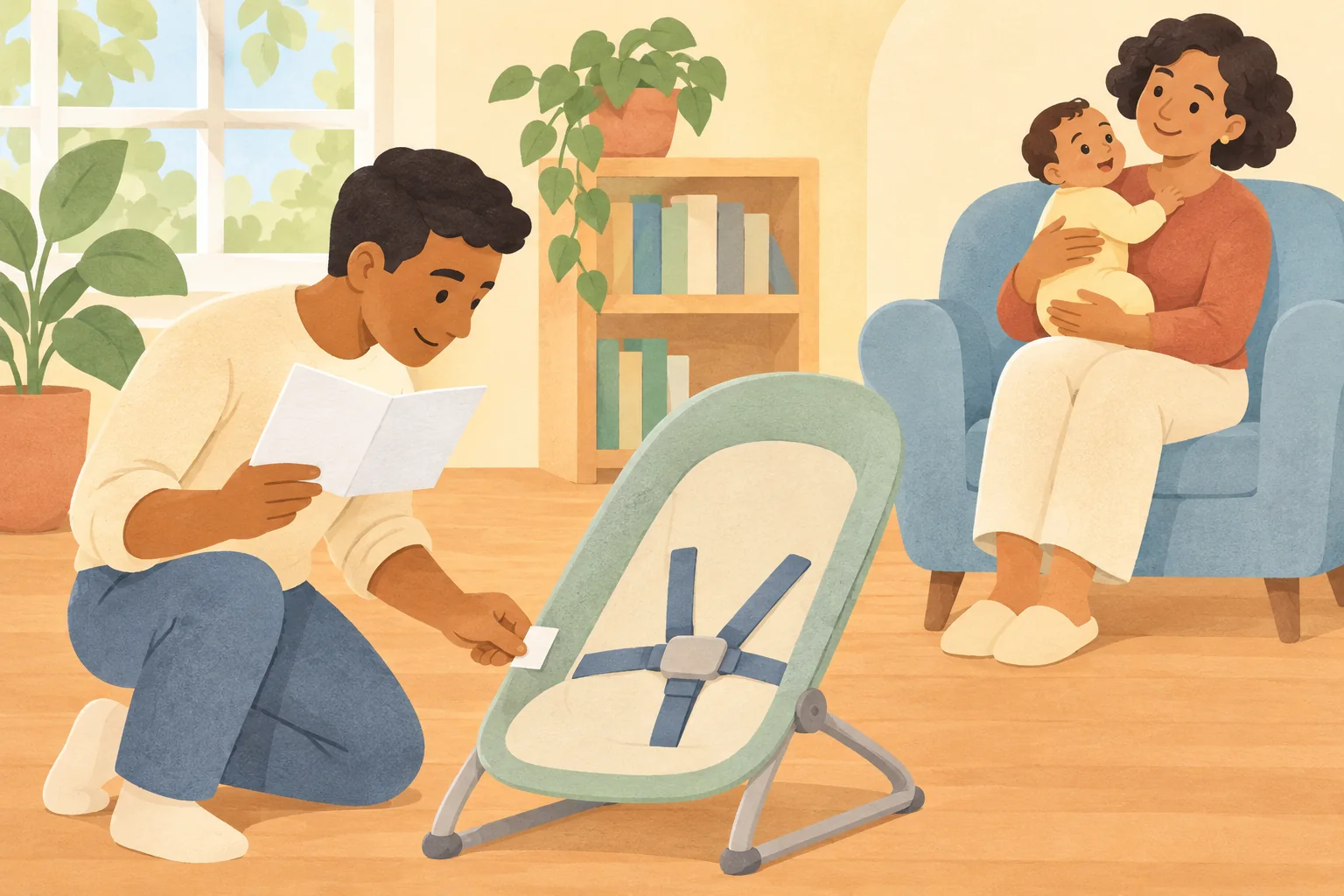
Use the actual label and manual, not an online photograph of a similar seat:
- Identify it. Find the brand, model and manufacturing details so you can obtain the correct instructions.
- Find every limit. Read the minimum-use conditions, weight maximum and developmental stop warnings for infant-bouncer mode.
- Check what has changed. Consider the movements you have already seen during ordinary care and play. Do not provoke a new movement in the seat as an experiment.
- Check local guidance. Apply the earliest relevant stop rule, including any stricter manufacturer instruction.
- Pause if uncertain. Keep the bouncer out of use while the manufacturer clarifies the product rule. Ask your baby’s health professional if you are unsure what a movement or individual care restriction means.
A large age range printed on a multi-use product may refer to another approved mode. It does not establish that infant-bouncer use continues throughout that range. Do not remove a harness, reverse fabric or convert the product based on a social-media tip. Any later mode needs its own verified instructions and readiness conditions.
Supervision does not extend a stop limit
“I will sit right beside them” is not permission to continue after the product has been outgrown. Nor is a tighter strap a way to overcome a developmental restriction.
Before a stop point is reached, CPSC advises floor-only use, correctly fitted restraints and an adult nearby watching. A table, kitchen counter, bed or sofa is not a suitable alternative location. These precautions apply during permitted use; they do not make continued use safe after a stop rule applies.
ACCC also says to remove the baby before adjusting the product and never carry a baby around in it. If a seat needs moving, lift the baby out first. Keep the empty product away from stairs, cords, heaters and other hazards when arranging the room.
Sleep needs a different place
A bouncer is not an infant sleep space, even when the baby looks comfortable or the adult is watching. Do not keep using an outgrown seat because it has become the familiar place where the baby dozes.
CPSC’s safe-sleep guidance says to move a baby who falls asleep elsewhere to an appropriate infant sleep product. Place the baby on their back on a firm, flat sleep surface in a suitable crib, bassinet or play yard, within that product’s own limits. Keep the space clear apart from its fitted sheet.
Do not add a cushion, pillow, rolled towel or positioner to change the bouncer’s angle or make sleep look safer. For a separate check of the actual sleep setup, see our crib-mattress fit guide.
Replace the routine the bouncer was filling
Think about when you relied on it: getting dressed, preparing food or having a short conversation. Plan those moments rather than buying another seat automatically.
The American Academy of Pediatrics recommends limiting time in bouncy chairs and varying awake positions, including holding your baby and closely supervised floor play. Tummy play is for an awake baby with close supervision; sleep remains on the back.
For a practical change, prepare a clear, safe floor-play area where an adult can remain with the awake baby. Keep pets, older siblings’ small pieces and household hazards out. If you cannot supervise that space while doing a task, pause the task or arrange another adult’s help. Do not simply move the same unsupervised routine from seat to floor.
Tell regular caregivers plainly: “We have stopped using the bouncer because this stop rule now applies. Here is our plan instead.” Put the seat away so it cannot slip back into use during a busy afternoon.
Keep retirement and product safety separate
A baby outgrowing a seat does not establish that the product is safe to pass on. Before storage, sale or donation, check its identity, condition, complete parts, instructions and any recall. Our baby-product recall guide covers that separate task. Do not pass on a recalled item outside its official remedy.
If an incident causes serious injury or a baby needs urgent medical help, call local emergency services. Product support is not an emergency-care service.
The useful endpoint is not “we reached the maximum weight”. It is that every caregiver knows the first stop rule, the seat is out of use when required, and the baby has a suitable place for the next part of the day.
Sources and further reading
- CPSC: infant-bouncer warnings and permitted-use precautions
- ACCC Product Safety: bouncer, rocker and swing guidance
- CPSC: safe infant sleep spaces
- AAP HealthyChildren: awake play and back-to-sleep guidance
Read our editorial policy and review methodology.