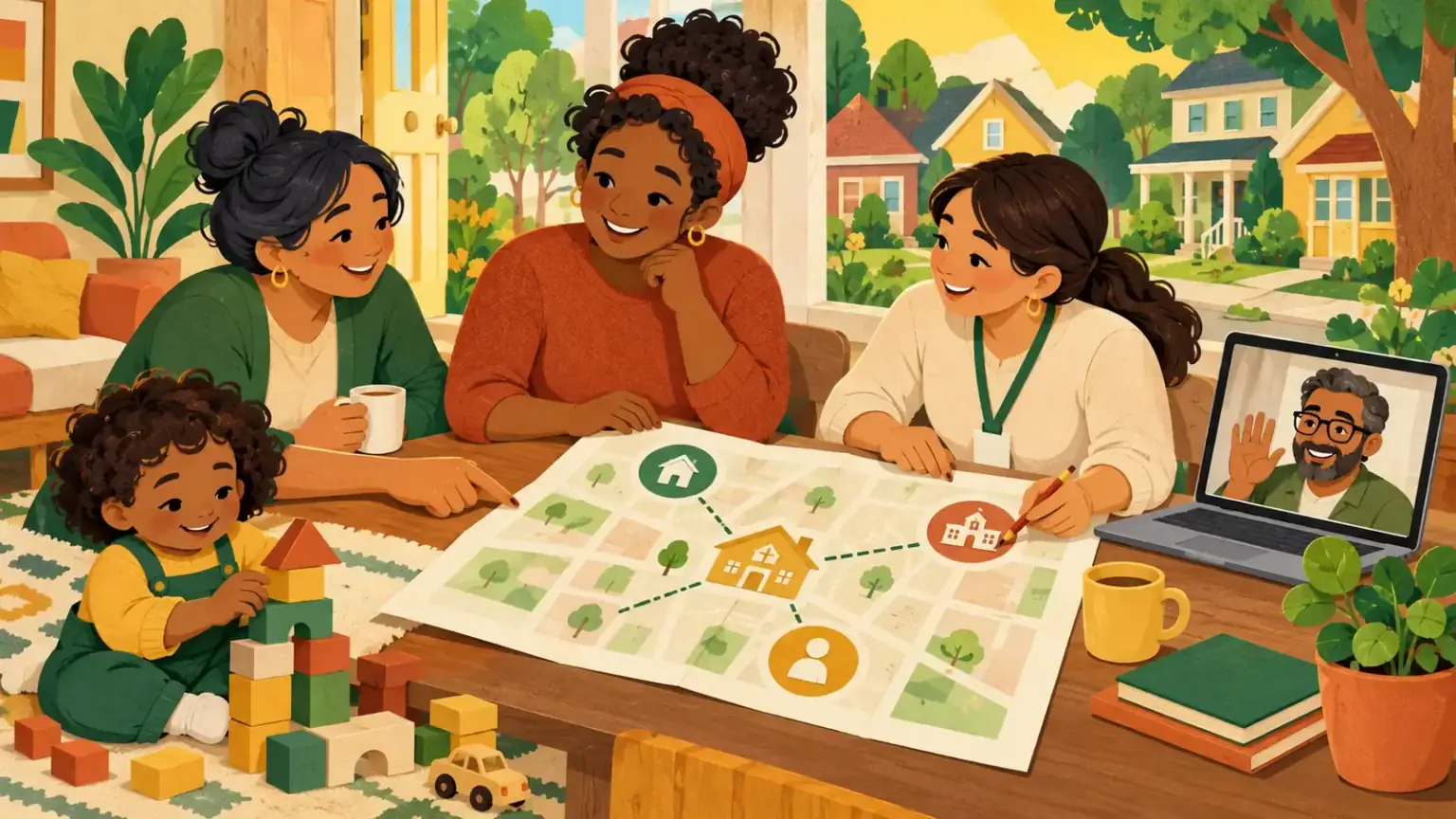
Living far from relatives can make every fever, school closure and late meeting feel like a private emergency. A support circle does not have to imitate a large extended family. It needs a few people and services with clearly understood roles, built gradually enough that trust is real.
Map four kinds of support
- Emotional: someone who can listen without judging.
- Practical: a person who might collect a child, bring food or lend equipment.
- Local knowledge: someone who knows schools, transport, health services or community routines.
- Professional: clinicians, teachers, social workers, parent-support services or disability organizations.
One person does not need to fill every role. Distant relatives may offer emotional continuity while a nearby neighbor handles a ten-minute emergency.
Begin with repeated contact
Notice adults you see regularly at pickup, a library, place of worship, building, playground or class. Start with small conversation and reciprocity. Friendship cannot be rushed into emergency childcare. Exchange details only when it feels safe, and meet new contacts in public places.
Make one small invitation
“Would you like to walk after pickup on Friday?” is easier than “We should connect.” After trust grows, make practical expectations explicit: allergies, authorized pickup, car-seat needs, accessibility, emergency contacts and what a helper is not expected to do. Specialized care requires training; goodwill alone is not enough.
Keep distant family involved usefully
Set a regular video call, bedtime story or check-in that does not depend on a crisis. A relative far away can research services, order groceries, listen during a difficult appointment or cover a child online while you complete a form. Give them a real task, not a running commentary they cannot act on.
Create a two-person backup
Choose a first and second contact for school pickup or urgent errands. Test the plan on a normal day. Store only necessary information and update permissions. Never post a child’s personal details in a broad neighborhood group.
Use services as part of the circle
Parent groups, community centers, health clinics and school staff can provide information and connection. UNICEF emphasizes that parenting is too large a job to do alone and that integrated services can support both skills and caregiver wellbeing. For a sensitive teen concern, understand who can help and what confidentiality means.
Ask specifically and accept a no
Use a bounded request: “Could you stay with the children for thirty minutes while I attend a telehealth appointment?” Let people decline without punishment. Reliability grows when expectations are honest. Offer reciprocity that fits your capacity, not an immediate debt you cannot afford.
If isolation is affecting mood or functioning, speak with a health professional. The NHS notes that regular contact, groups and shared activities can help loneliness, while urgent support is important when you cannot stay safe.
A support circle is not measured by group size. It is measured by whether you know whom to contact, they know what is being asked, and the arrangement protects both the child’s safety and the helper’s boundaries. If you also need to distribute recurring tasks, use the caregiving-load map. When your confidence is low, remember you do not have to be the crafty parent—support can expand what your family can access without requiring you to master everything.
Review trust, not just availability
Notice whether a helper follows instructions, respects the child’s communication, arrives when agreed and tells you about problems. Give children a private way to say how the arrangement felt. A person being generous does not override a child’s discomfort or safety. Change the plan when trust is not earned.
Review contact details and permissions every few months, especially after a move, school change or family transition. Remove people who are no longer available and thank those who remain part of the plan.